
Last updated September 20, 2026
Full 25-point door and opener safety check with every visit - springs, cables, rollers, tracks, and your LiftMaster or Chamberlain opener included
You get a price before we start. It does not change when the truck arrives.
 Before
 After
After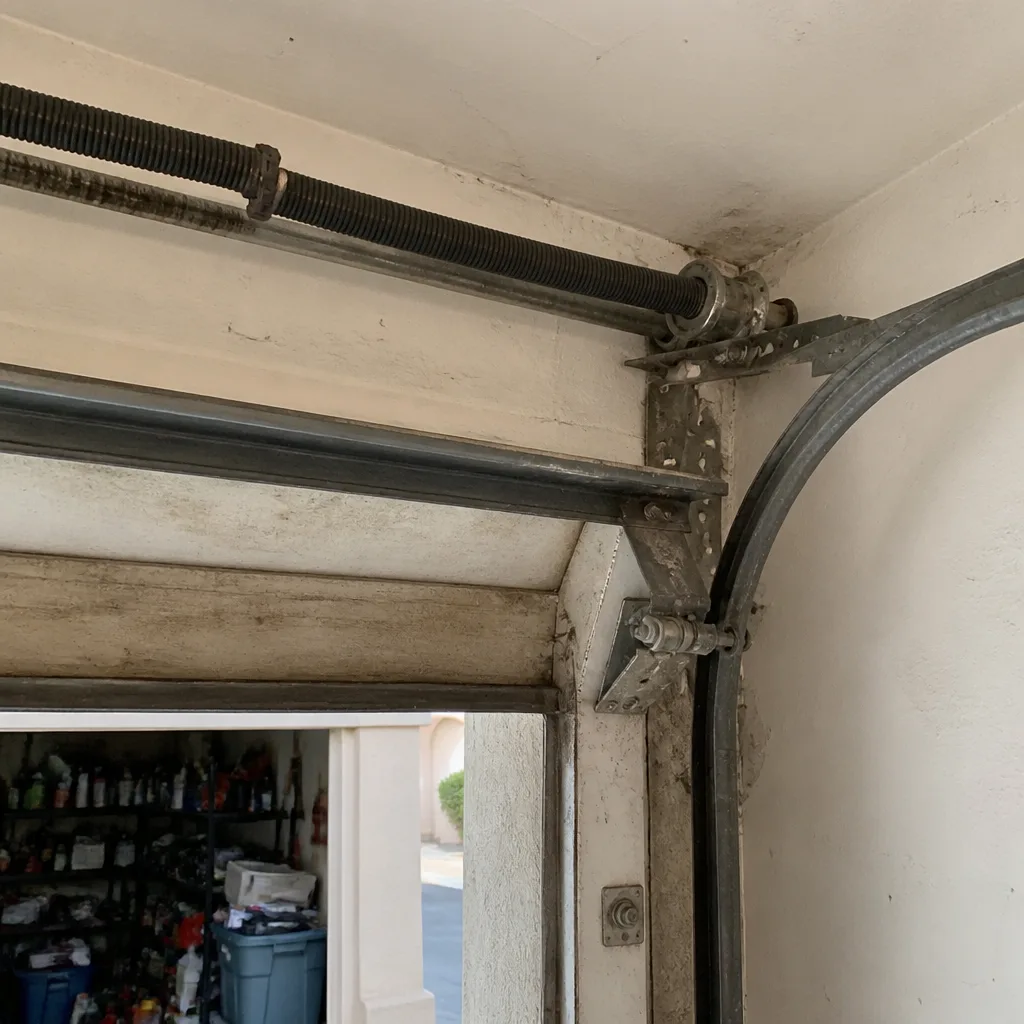 Before
 After
After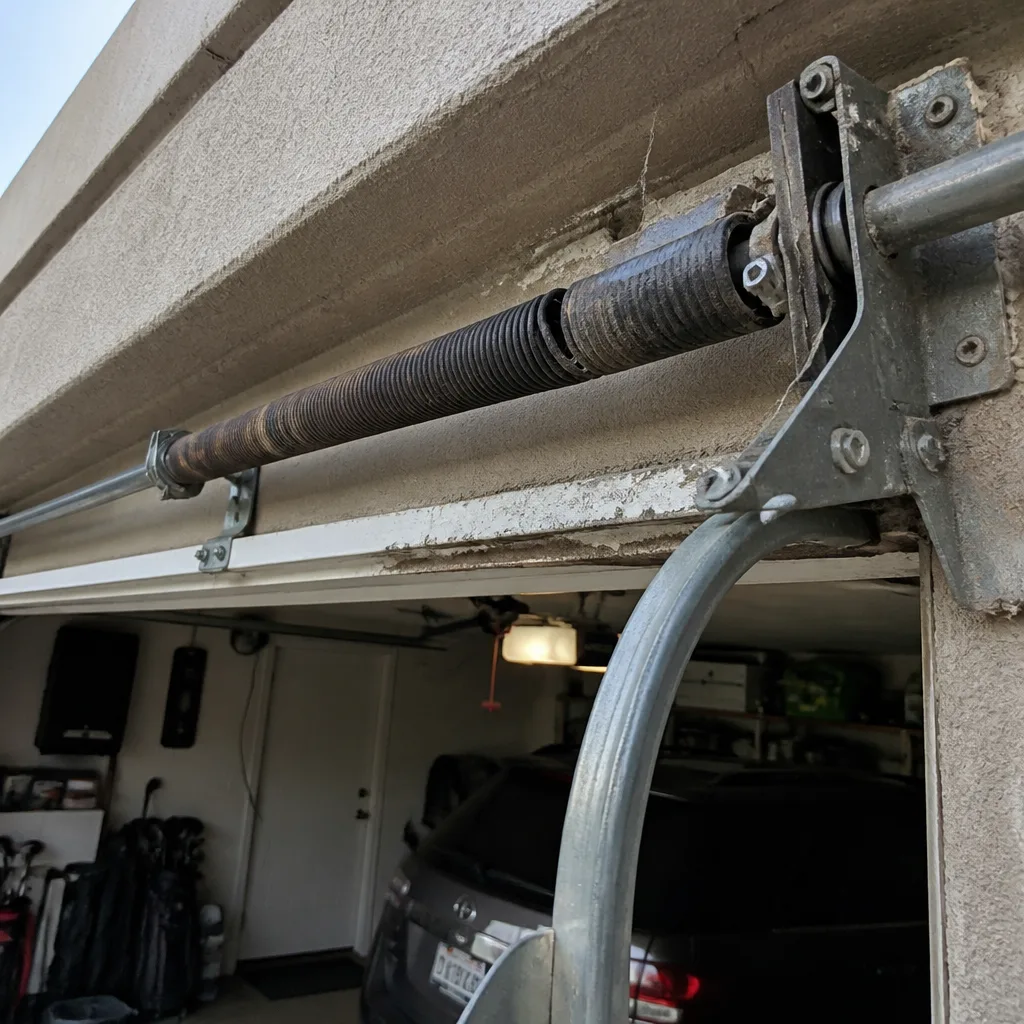 Before
 After
AfterGarage Door Warning Signs: A Chandler Homeowner’s Reference Guide
A garage door that reverses before fully closing is not always a sensor problem. It is also the symptom of a broken spring, a cable off its drum, or a track obstruction, and each of those has a different repair cost by a factor of five. Most Chandler homeowners wait until the door stops moving entirely before they call anyone, which turns a $40 roller replacement into a $600 opener rebuild. This guide maps what you see and hear to what is actually failing, so you know whether to schedule service next week or stop using the door tonight. For a broader overview, see The Complete Guide to Garage Door in Chandler. If you own a home in Chandler, especially in the neighborhoods east of the 101 or down toward Sun Lakes, this reference is written for your door, your climate, and the way garage components fail in the Sonoran Desert.
Quick Answer
The warning signs that matter in Chandler are specific, not general: a grinding sound on the upstroke that stops halfway up, a visible gap in a torsion spring, a door that drifts down after being opened by hand, a slow-motion open cycle, or a cable that hangs loose when the door is closed. Each of these maps to a distinct component with a distinct repair cost, from a $35 roller swap to a $600 full spring replacement. A generic “the door is noisy” is not a diagnostic signal; the type of noise, when it occurs, and whether the door still balances by hand is. Operate the door manually only if it is already closed, and never touch the torsion spring hardware: it is under lethal tension even when the spring looks broken.
Table of Contents
- Symptom-to-Component Diagnostic Table
- How to Tell a Torsion Spring Under Tension From a Broken One
- Why a Slow Door Is Often More Expensive Than a Stopped Door
- What to Photograph Before Calling a Technician
- Warning Signs That Mean Do Not Operate the Door
- Chandler-Specific Failure Patterns: Heat, Dust, and Monsoon Season
- What a Homeowner Can Safely Check (and What You Should Not Touch)
- Common Mistakes to Avoid
- When to Call a Professional
- Frequently Asked Questions
BeforeAfterSymptom-to-Component Diagnostic Table
The first rule of garage door diagnosis is that the symptom and the failed part are not the same thing. A door that jerks on the way up could be worn rollers, a bent track, or a spring that has lost half its tension. The difference matters because a worn roller is a $35 fix and a spring replacement in Chandler runs $180 to $340. When we arrive at a home in Chandler with a written price before any work starts, the technician is not guessing at the cause. The photo record and the measurement come first, the quote comes second. Here is the table we use to narrow down what you are describing:
| Symptom You Observe | Likely Component | Urgency Level | Cost Range in Chandler |
|---|---|---|---|
| Grinding noise on upstroke, stops at halfway point | Worn roller bearing or track section | Moderate: schedule within 1 week | $35 to $120 |
| Door reverses before fully closing, sensors clean | Broken torsion spring, cable off drum, or track obstruction | High: do not force the door closed | $180 to $340 for spring; $120 to $180 for cable |
| Door drifts down after being opened by hand | Weak or broken balance spring | High: do not operate | $180 to $340 |
| Slow-motion open or close cycle, no noise change | Opener motor, logic board, or limit switch | Moderate to high | $150 to $400 for opener components |
| Loose cable hanging next to door when closed | Broken cable or drum wrap failure | High: do not operate | $120 to $180 per side |
| Door leans to one side, gaps visible at meeting rails | Broken corner bracket or misaligned track | Moderate | $80 to $150 |
| Loud bang during operation, door shakes | Broken spring coil | Immediate: stop using door | $180 to $340 |
These ranges reflect the flat pricing we have delivered across Chandler since 2015, from Cooper Commons to the Ocotillo area. The point is not that the numbers are final; it is that a written price should exist before any work begins. Clause 1 of The Haven Standard requires it. A company that will not put a number on the page before sending a technician has not yet decided what they want from you.
How to Tell a Torsion Spring Under Tension From a Broken One
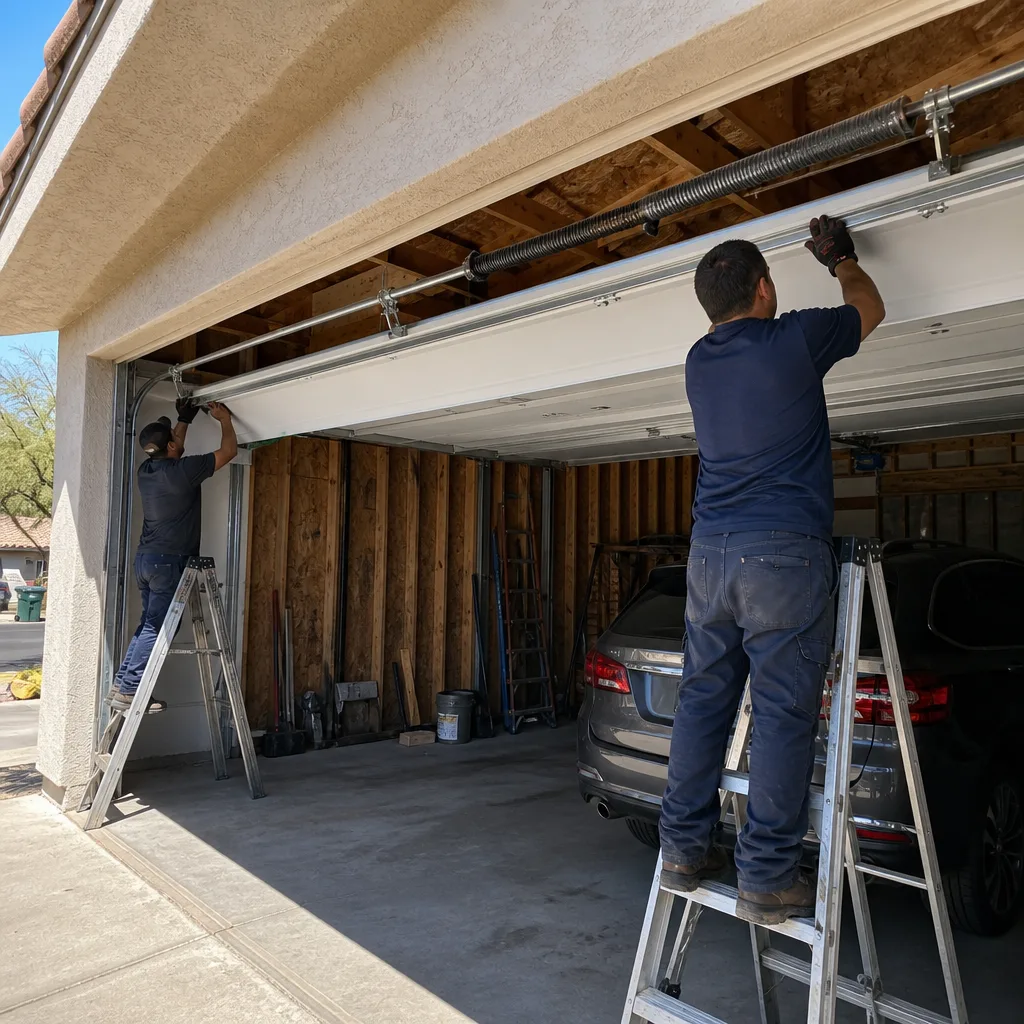
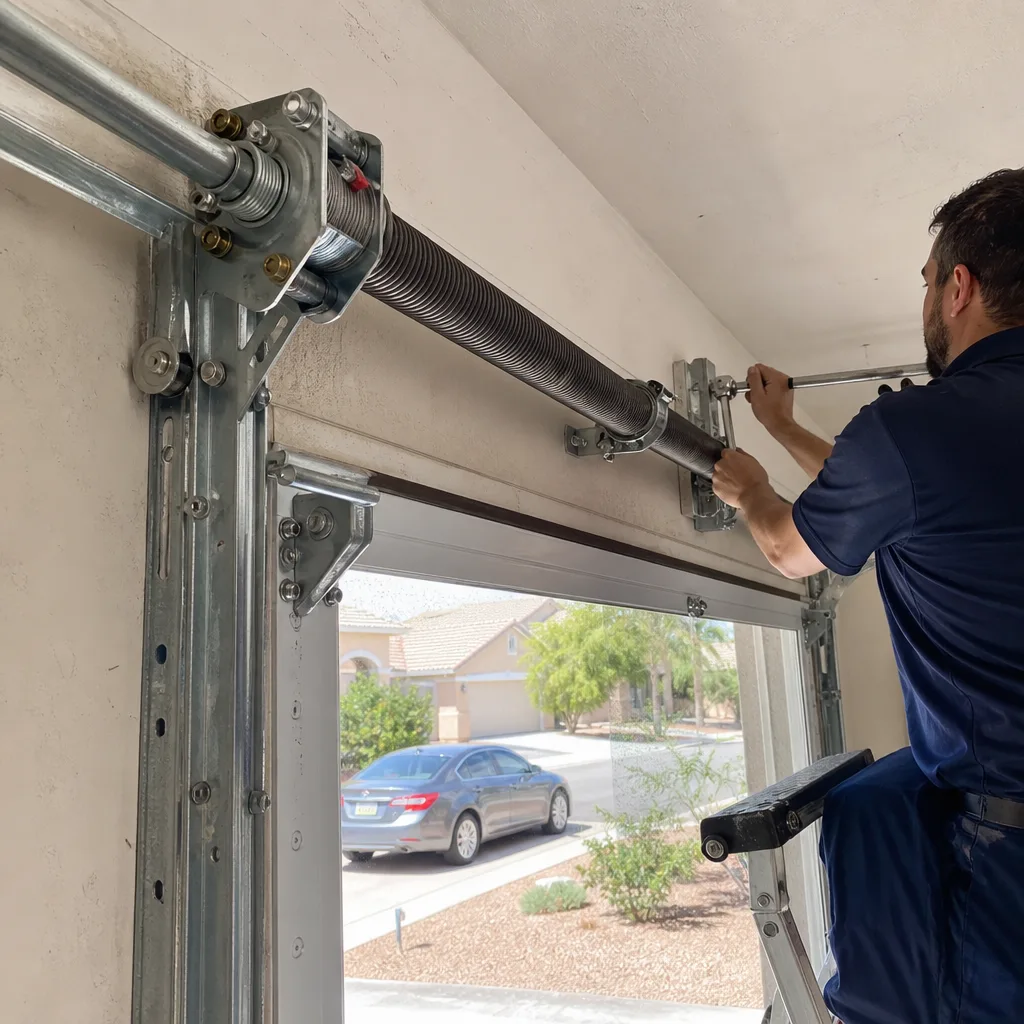
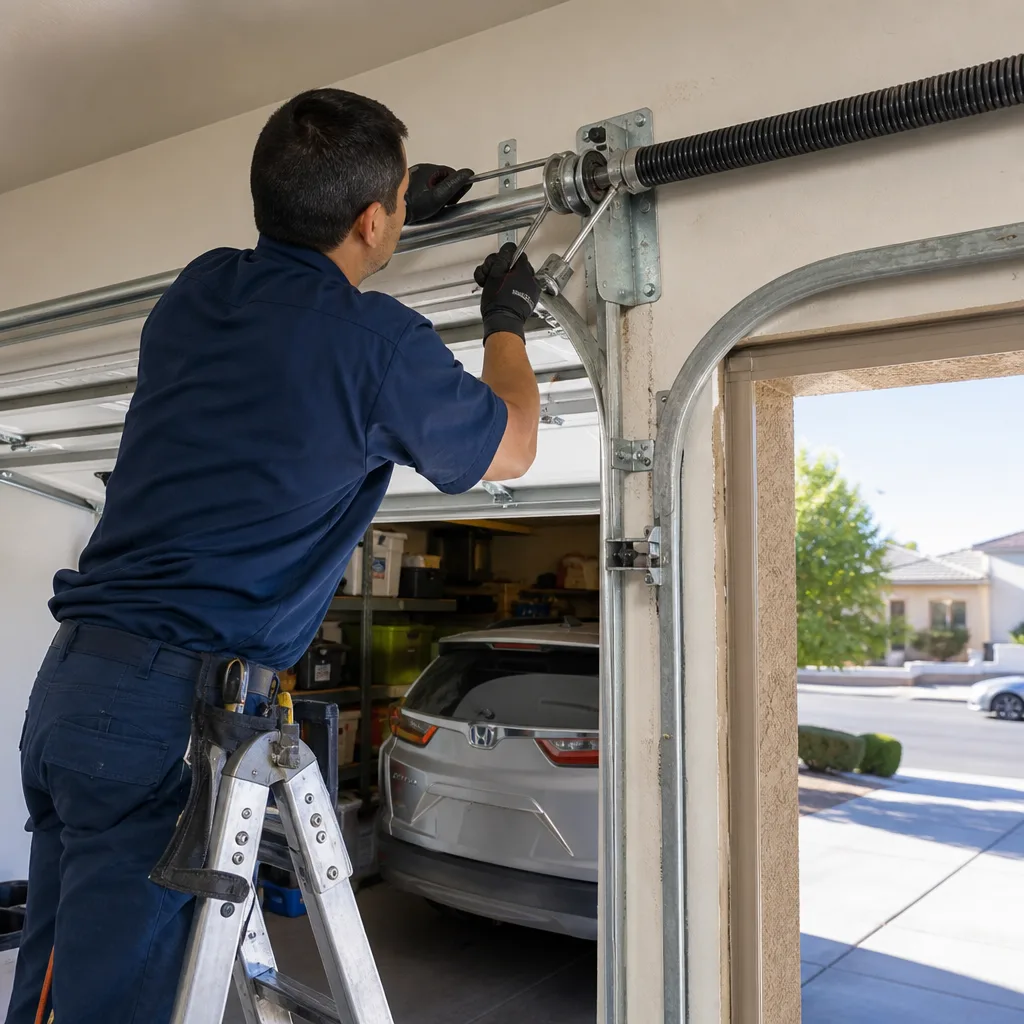
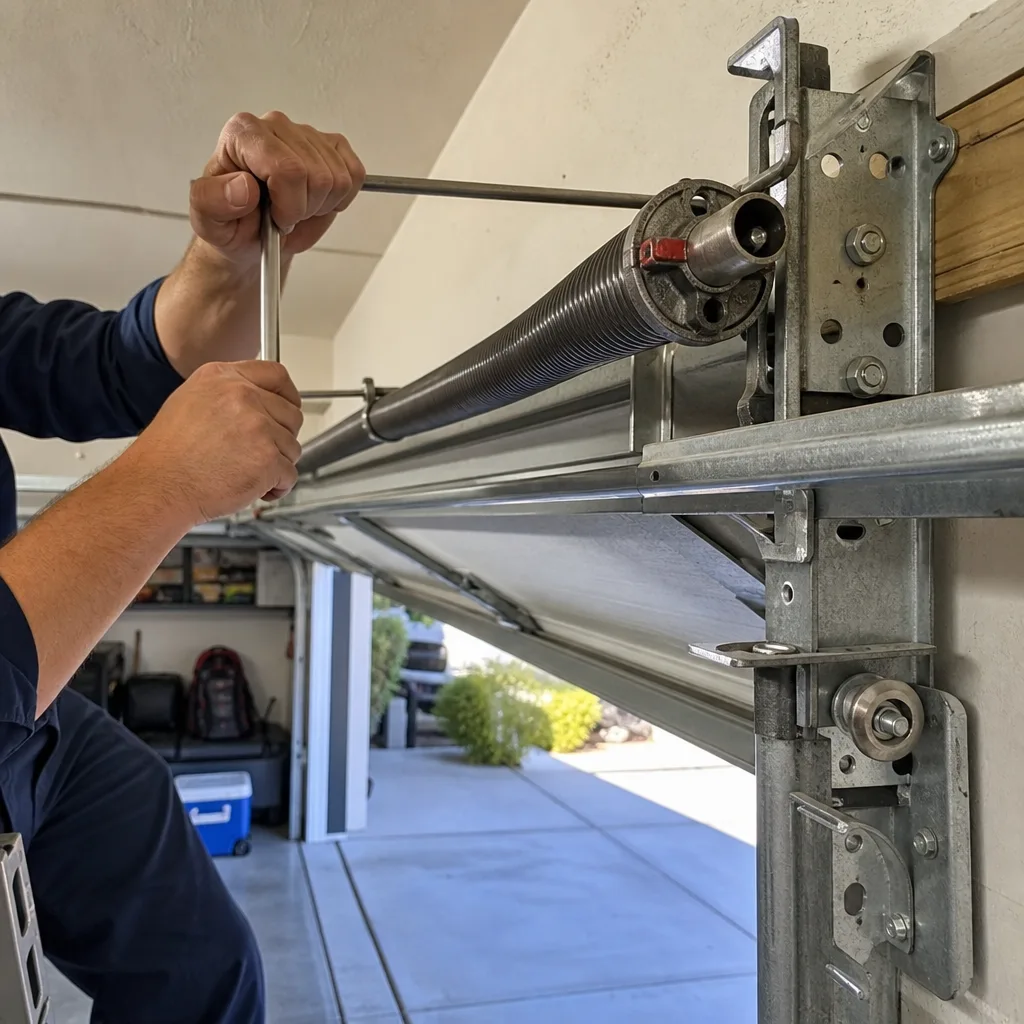
A torsion spring is the coiled steel shaft that sits horizontally above the door opening, usually centered on the header. It stores the lifting force for the door. When the door is closed, the spring is under maximum tension. When it is open, the spring has released most of that tension. The distinction between an intact, loaded spring and a broken one is visible even from a few feet away, and it does not require touching anything.
What an intact, tensioned spring looks like:
- A continuous coil with no separation between the individual coils. The metal forms a single, unbroken spiral from end to end.
- No gap larger than the width of a dime anywhere along the length.
- The spring feels visually “tight,” like it is holding energy. In a two-spring system, both springs look identical.
What a broken spring looks like:
- A visible gap, often two to four inches wide, between two sections of coil. This gap usually appears near the center of the spring or at one end where it mounts to the center bracket.
- Coil windings that have shifted slightly, so the metal spiral looks interrupted and irregular, like a stretched binder clip.
- In a two-spring system, one spring looks normal and the other looks broken. The door still opens, but it is doing so on half its original lifting force.
What a broken spring sounds like:
The failure is loud. Homeowners across Chandler describe it as a gunshot, a car backfiring, or a heavy steel plate hitting concrete. It happens in an instant, usually when the door is fully closed or just beginning to open. After the spring breaks, the door may not open at all, or it opens very slowly and unevenly. The sound is not subtle.
Safety note: never approach a torsion spring with a tool, a pry bar, or your hands. Even a broken spring is dangerous because the unbroken section on the other side of a two-spring system remains under full tension. A spring that appears to have snapped on one side is not “safe” because the other side can launch the entire shaft. Clause 4 of The Haven Standard is why a Servo technician photographs the failed component before quoting a replacement: the customer sees the break, sees the measurement, and sees the written price in the same visit. You do not need to get close to confirm the break. Stand at arm’s length from the door, look up at the spring, and take a photograph with your phone.
Why a Slow Door Is Often More Expensive Than a Stopped Door
This is counterintuitive, so let it sit for a moment. A garage door that will not open at all is usually a broken spring or a failed opener. The diagnosis is fast, the repair is standard, and the cost is contained. A garage door that opens normally but takes twelve seconds instead of six, or creeps upward while making a strained sound, is telling you something about a motor, a logic board, or a drive system that is failing progressively. Progressive failure is more expensive than catastrophic failure in the garage door trade because the progressive case involves multiple parts wearing toward failure at different rates.
Here is the repair cost disconnect, based on what we have replaced across Chandler since 2015:
- A stopped door with a cleanly broken spring: one component, one diagnosis, a $180 to $340 repair, done same day.
- A slow door with a laboring motor: the opener motor may be pulling excessive amperage because the door is out of balance, which means the spring has already lost tension, and the motor has been straining for months. The fix involves a spring replacement plus an opener repair or replacement, with a combined cost that can exceed $500.
- A slow door with a clicking limit switch: the switch that tells the opener when to stop running is failing. Replacing just the switch is $150 to $250. Replacing the entire opener head is $300 to $500 installed.
A slow door in Chandler is also a seasonal issue. The Sonoran Desert heat bakes the plastic gears inside a LiftMaster, Genie, or Craftsman opener head. When the nylon drive gear inside the opener strips, the door still moves, but it moves slowly and noisily. The replacement part is inexpensive; the labor to disassemble the opener head is the same whether you catch the gear today or after the motor burns out. The earlier you diagnose a slow door, the fewer parts fail. If your garage door opener is more than eight years old and the door is moving noticeably slower than it did two years ago, call a technician to inspect the motor and the balance spring in the same visit. That visit costs less than either repair.
What to Photograph Before Calling a Technician
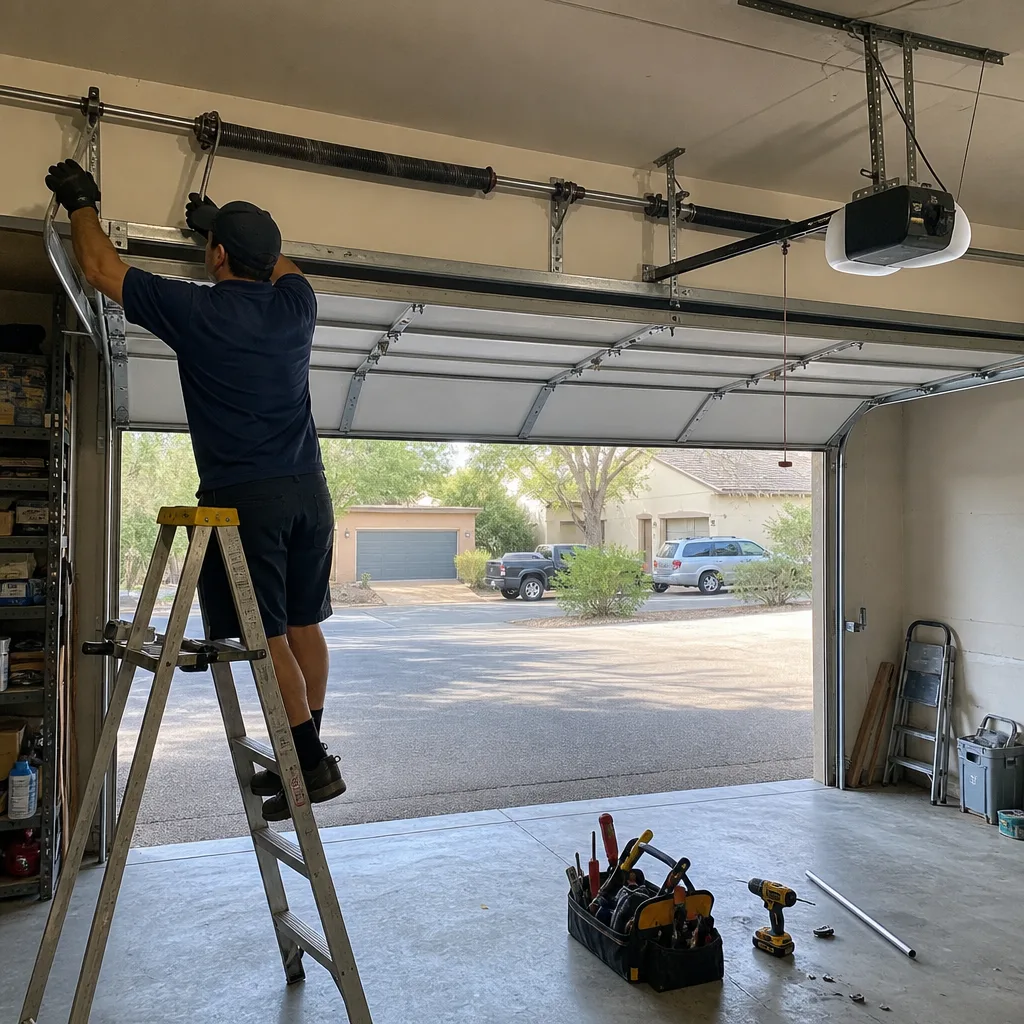
A service call in Chandler is faster and cheaper when the office can assess the problem from photographs. We do not use a camera to replace a technician’s eyes; we use it to make sure the technician shows up with the right parts and the right price. Clause 4 of The Haven Standard requires the technician to photograph the failed component before quoting a replacement, so the photo record is already part of every job. You can help the process by sending photos before we arrive.
Here is the six-photo sequence we ask for:
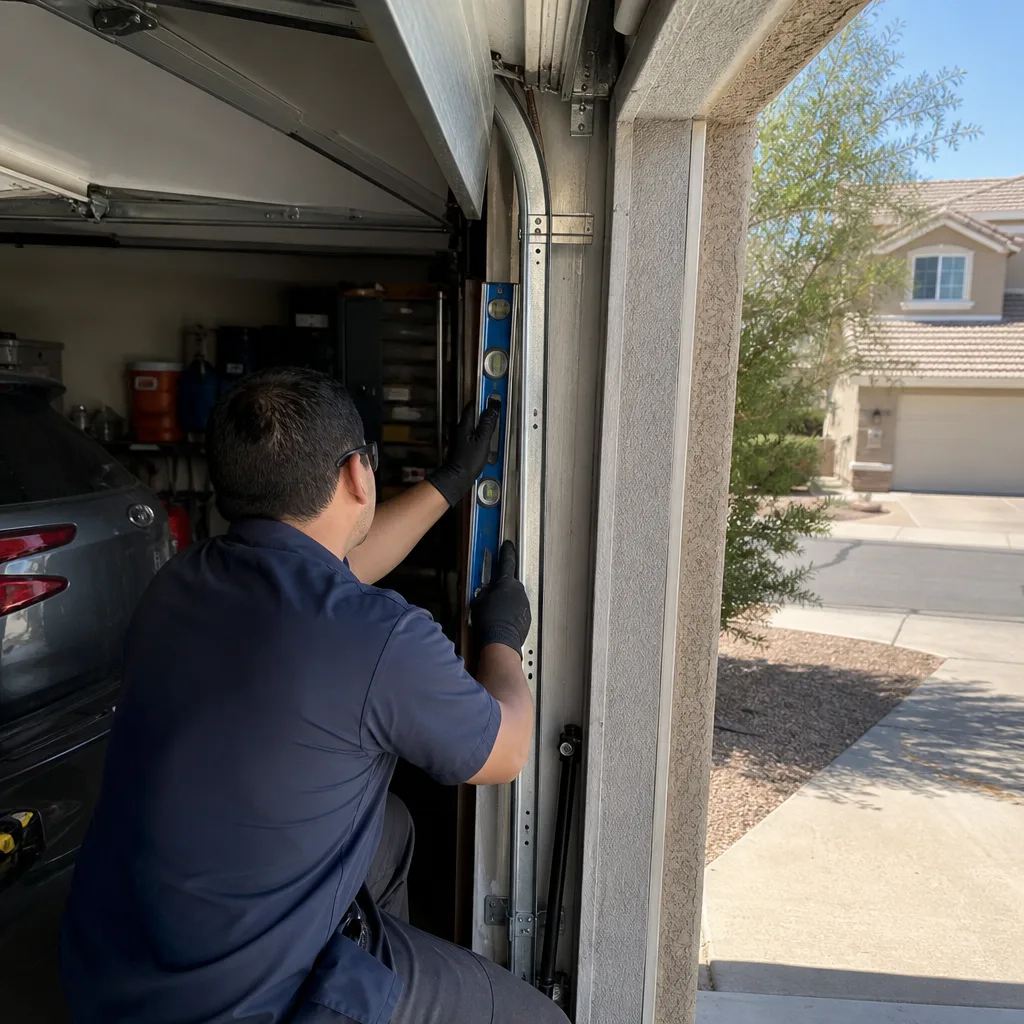
- The full door from inside the garage, closed. Stand about eight feet back. This shows overall track alignment and any structural sag.
- The torsion spring above the door, center-mounted, no zoom. This shows coil separation and whether one or two springs are present. Do not climb a ladder to take this; a phone held at chest height with the flash on is enough.
- The cable drum on the left side, where the cable wraps around the pulley. This shows a frayed cable or an unwound drum. The cable drum sits at the top of the track where it meets the wall.
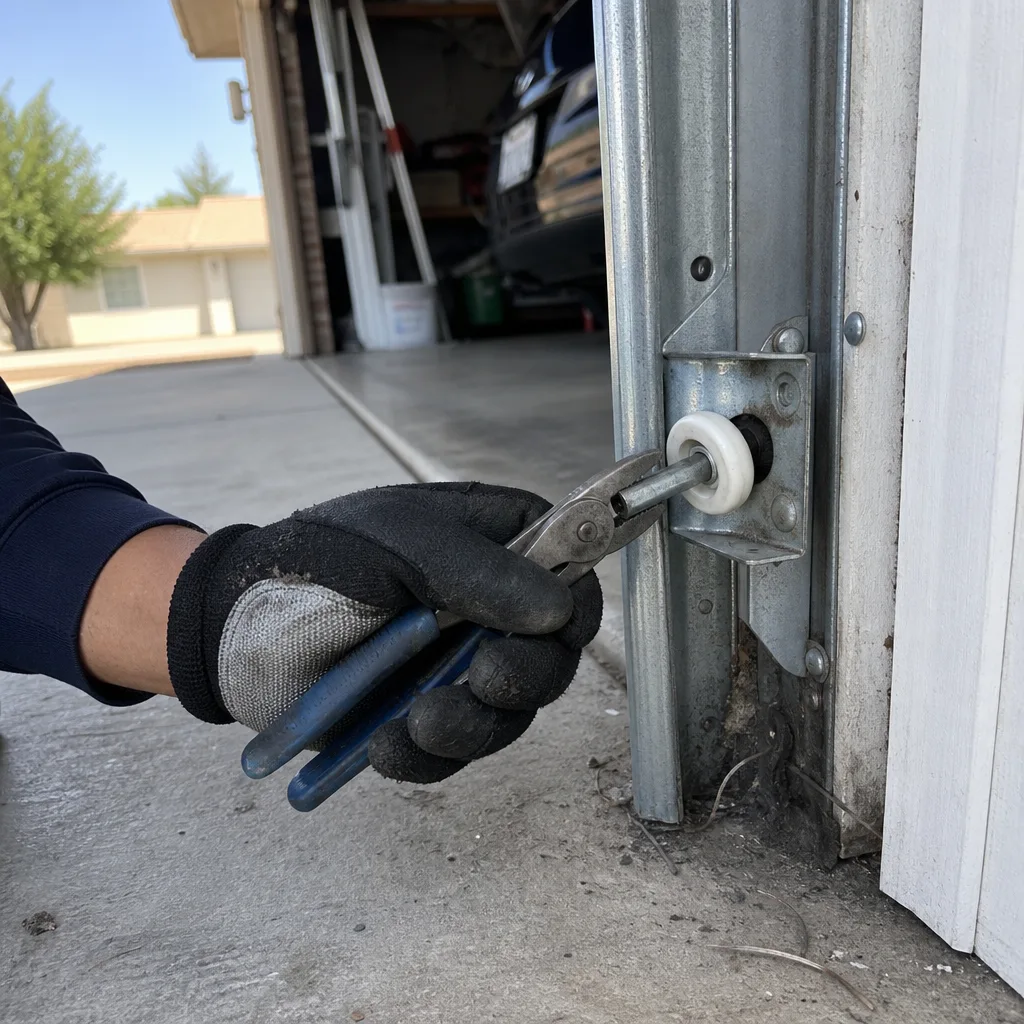
- The roller at the bottom of each side track. Camera about two feet away, aimed at the roller stem. This shows a cracked wheel or a bent stem.
- The opener motor unit, from below. This shows the brand name, the model tag, and any visible gear dust on the housing. Wayne Dalton and Raynor openers share drive styles with LiftMaster and Chamberlain, but the model tag tells us which specific replacement parts fit.
- The gap between the door and the concrete when the door is closed. This shows whether the door is sealing evenly or bowing at the bottom panel.
Send these with a note about what you heard and when the problem started, including the time of day. In Chandler, a door that only reverses during the hottest part of the afternoon is sometimes a sensor overheating issue, not a misaligned eye. A noise that appears only at night when the air cools can indicate a spring contracting in the temperature drop. The more specific the observation, the closer the quote matches the final invoice. Our office is answered by a live person 24/7, and the photos you send go to the technician who will be at your door, not to a corporate call center.
Warning Signs That Mean Do Not Operate the Door
There is a short list of conditions that should stop you from operating the door manually or with the opener. These are not “get three quotes” situations. These are “leave the door where it is and call a professional” situations. The distinction matters because forcing a door with a broken balance spring can tear the garage door track off the ceiling, and that is a $500 to $1,200 repair in Chandler instead of a $180 to $340 spring replacement.
Do not operate the door if any of the following are true:
- The torsion spring has a visible gap or looks stretched. The door is no longer balanced, and the opener motor will burn out trying to lift the weight.
- A cable is loose, frayed, or hanging when the door is closed. A cable failure on one side can cause the door to drop with force on the other side.
- The door drops more than a few inches when you release it from the opener by hand. A properly balanced door stays in place when opened halfway. If it falls, do not keep testing it.
- You see the track pulling away from the wall. This indicates the track bracket is failing or the door is binding badly. The door should not be moved until the bracket is re-seated.
- Any bolt, nut, or bracket appears loose near the spring or cable hardware. Do not tighten it yourself. The spring is under tension, and a wrench on the wrong bolt can release that tension into your hand.
If you are not sure, the rule in Chandler is simple: get a written assessment before anyone touches the door. The free estimate is free, and a technician who stands in your driveway and says “the spring is broken, here is the photo, here is the written price” is doing their job. If you want to vet contractors before calling, read How to Hire a Garage Door Contractor in Chandler: A Step-by-Step Guide. A technician who says “let’s just force it open” is not. You should never operate a garage door that is visibly damaged, and you should never pay for a repair that was not described to you in writing before the work began.
Chandler-Specific Failure Patterns: Heat, Dust, and Monsoon Season
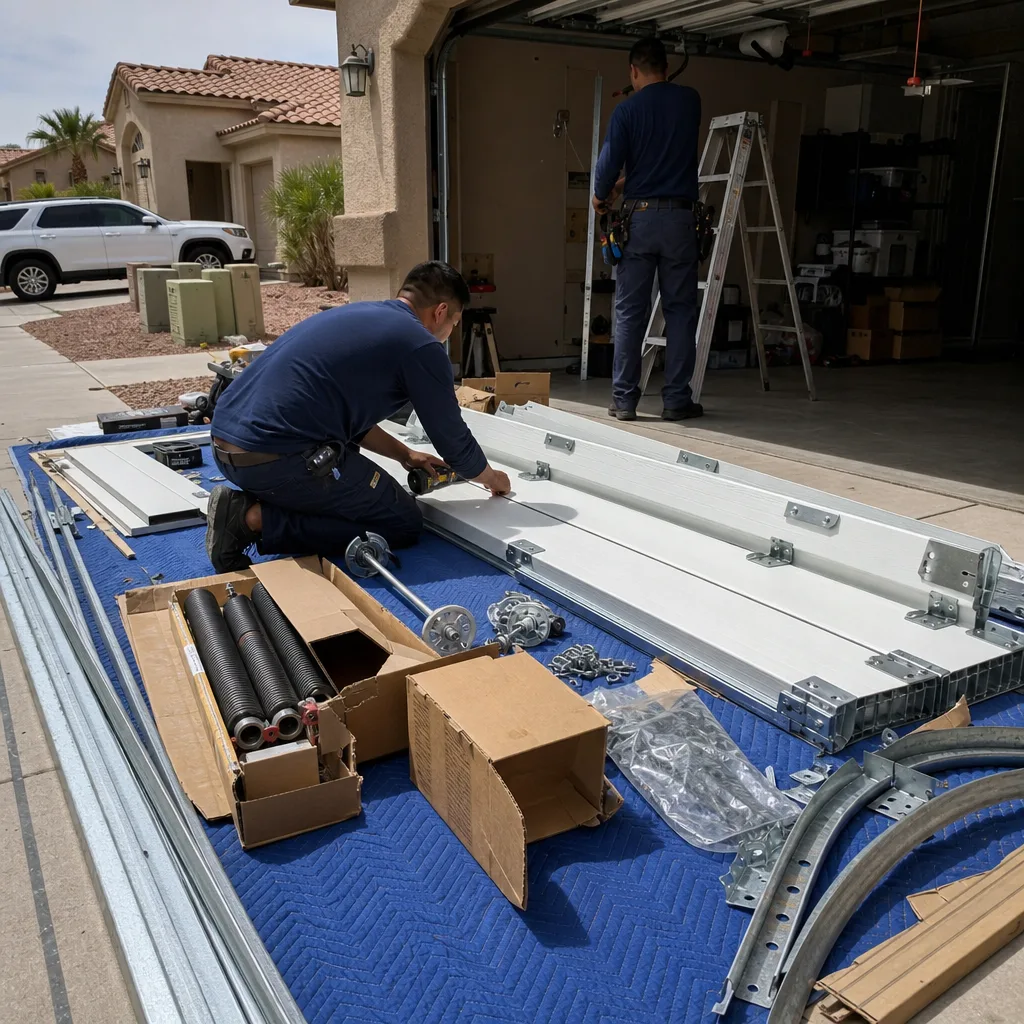
Chandler’s climate is uniquely hard on garage doors. The city sits at 1,200 feet, summer highs run 105 to 115 degrees for weeks at a time, and the dust that blows through every August monsoon season is fine enough to work its way into a roller bearing. These conditions do not affect every garage door in America, but they affect every garage door in Chandler. Here is what we replace most often at Servo Garage Doors Chandler home:
- Nylon rollers with worn bearings from dust ingress. A roller that grinds on the upstroke and then quiets halfway up is usually a bearing full of grit, not a bent track.
- Opener drive gears stripped by heat. The nylon gear inside a LiftMaster or Craftsman opener head softens at garage temperatures above 110 degrees, then strips under repeated use.
- Torsion springs that lose tension faster in Chandler’s heat. Steel expands and contracts daily, and the spring’s rated cycle life (usually 10,000 cycles) arrives faster when the temperature swing is 35 degrees every day.
- Bottom seals that dry out and crack after two or three summers. A cracked seal lets dust and monsoon water into the garage, which accelerates roller wear and panel corrosion.
Monsoon season, July through September, brings a second set of problems. The wind drives fine dust into every gap, and a door that sealed fine in February suddenly whistles and rattles in August. The humidity is brief but high enough to rust an already-cracked spring or corrode a cable end. If your door sounds different after a monsoon storm, the storm did not cause the problem; it exposed it. The fix was already scheduled by months of wear; the storm just made it audible.
For Chandler homeowners, the practical advice is an annual inspection of the rollers, springs, and seals, timed to early October after the last monsoon storm and before the winter cold cycle begins. It is a $79 visit, and it catches the $35 roller before it becomes the $600 opener rebuild. If you bought your home in Chandler between 2015 and 2025, the door that came with the house is probably original to the build, and it has been through eight to ten desert summers already. That door is due for a component-level checkup.
Servo Garage Doors Chandler has served the city since 2015, and Garage Door Repair in Chandler is our core trade: spring replacement, cable re-wrap, roller swap, and track alignment. The written price you see on the table above is the price you get, with no dispatch fee hidden behind the word “estimate.”
What a Homeowner Can Safely Check (and What You Should Not Touch)
There is a narrow band of garage door maintenance that is genuinely safe for a Chandler homeowner, and a much wider band that is not. The safe band includes observation, photography, seal inspection, and sensor alignment. The unsafe band includes any work that involves the spring hardware, the cables, or the bottom brackets. The distinction is not about skill; it is about tension. A torsion spring under tension stores enough force to break a forearm or crush a hand. The cable drum holds that same force when the door is closed. These are not components you adjust with a socket wrench from a home center.
Safe to check on your own:
- The bottom seal: run your hand along it while the door is closed. If it cracks, tears, or lets daylight through, it should be replaced. This is a $45 to $80 part installed.
- Sensor alignment: the two photo eyes at the bottom of each track should have aligned indicator lights. If one light blinks or both are dark, check for dust or a shifted bracket. Wipe the lens with a dry cloth and realign the eye by hand.
- Roller wear: with the door closed, look at the rollers at shoulder height. A wheel with visible flat spots, cracks, or wobble should be replaced. Do not remove a roller from a bottom bracket yourself; leave that to the technician.
- Track obstruction: run a rag along the track on both sides, checking for pebbles, monsoon debris, or caked dust that might catch the roller stem.
Do not touch or adjust:
- The torsion spring, the set screws on the spring collar, or the spring winding cone.
- The cable drums and cables above the track.
- The bottom bracket that holds the bottom roller and the cable end.
- Any bolt near the center bracket where the torsion spring is mounted.
If a repair requires a tool on any of those parts, call a professional. Garage Door Installation in Chandler often involves re-tensioning springs, and the work should only be done by someone with the winding bars and the torque training. The good news is that the dangerous components are also the most standard repairs in the trade, and a qualified technician in Chandler can replace a torsion spring safely in about 45 minutes with the door functioning again by the time they leave.
Common Mistakes to Avoid
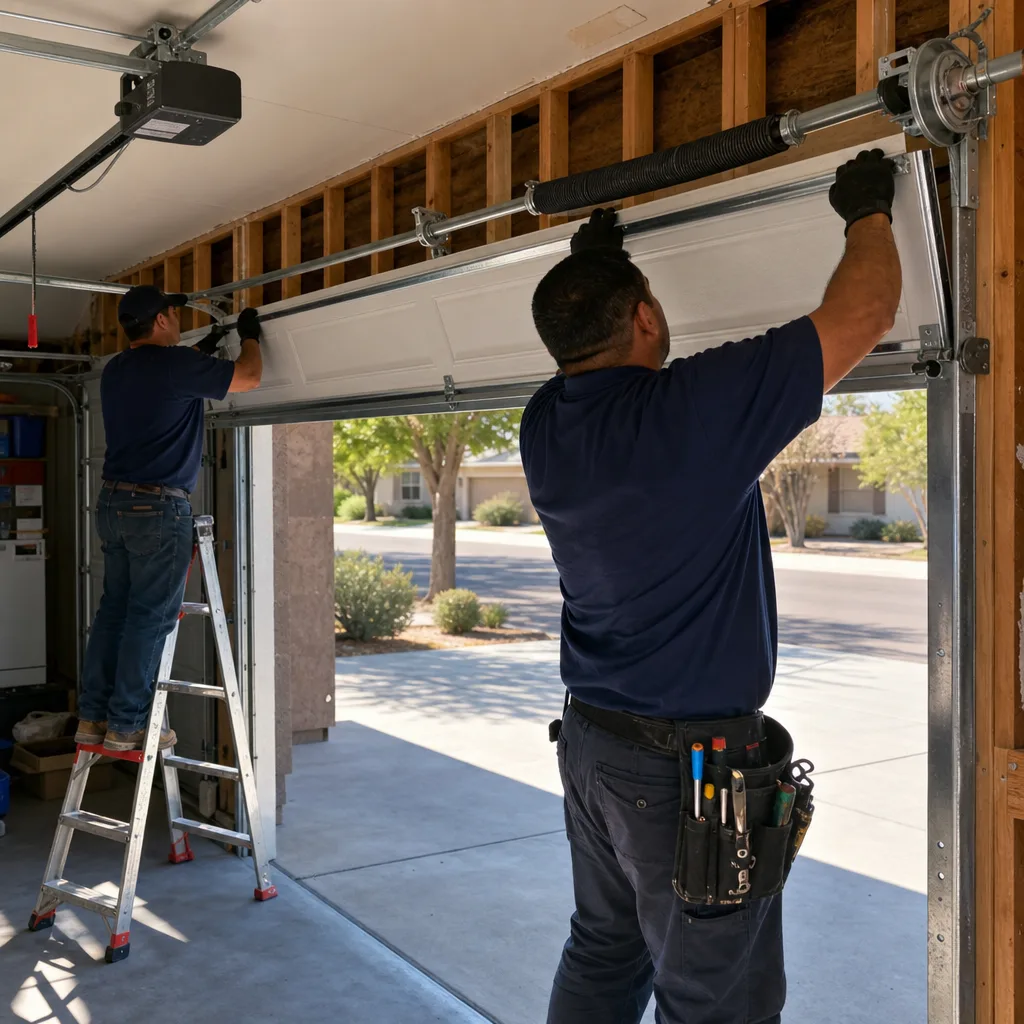
- Treating every noise as “the door is old.” A grinding sound that stops halfway up the cycle points to a specific roller location. A rubbing sound that continues through the full cycle points to a track section. Neither one is “just old.”
- Forcing the door open when it will not budge. This is the single most expensive mistake we see in Chandler. Forcing a door with a broken spring bends the track, tears the cable, and burns out the opener motor. The original spring repair would have been $180 to $340. The forced-open rebuild is $800 and up.
- Replacing the opener before checking the door balance. A garage door should balance by hand with the opener disengaged. If it does not, the problem is the spring, not the motor. Replacing a perfectly good opener because the door will not lift is a $400 to $600 error.
- Lubricating the spring with WD-40. The spring does not need lubrication, and WD-40 attracts dust that accelerates wear in Chandler’s air. Use a silicone-based garage door lubricant on rollers and hinges only, and never on the spring coils themselves.
- Ignoring a door that runs but moves slowly. A slow door is often a spring that has lost tension and an opener motor that is now working against an unbalanced load. Delaying the inspection by six months turns a spring repair into a spring plus opener repair.
- Calling the first company that answers without checking their price policy. In Chandler, a garage door repair company that will not put a written price in front of you before starting work is not a company that respects your time. Clause 1 of The Haven Standard exists because our customers told us they had been quoted one price on the phone and charged another at the door. A written scope and a flat price stop that.
- Attempting to adjust the limit switch without understanding what it does. The limit switch tells the opener where to stop. An adjustment in the wrong direction can cause the door to crash into the concrete repeatedly, and that repeated impact breaks panels and bends tracks. Let the technician set the limit; it is a two-minute adjustment included in the service call.
When to Call a Professional
Call a garage door professional when the door makes a new noise you can describe specifically, when the door moves differently than it did a month ago, or when you see any of the warning signs in the diagnostic table above. The best time to call is the day you notice the change, not the day the door stops. Most Chandler garage door repairs take less than an hour on site, and the cost is lowest when the failure is caught as a $35 roller or a $120 cable before it cascades. A broken spring should be replaced by a technician with winding bars and the experience to handle live tension; it is a same-day repair for a qualified shop, not a do-it-yourself project. Servo Garage Doors Chandler offers free estimates in Chandler with a flat, written price before any work begins, and the phone is answered by a live person 24/7, including holidays. Call (520) 482-1879 for a free estimate, or use the Garage Door Opener Repair & Installation in Chandler service page for opener-specific diagnosis. If you have an estimate from another company, bring it in: the Free Second Opinion is part of how we work, not a promotion.
Frequently Asked Questions
Garage door repair in Chandler ranges from $35 for a roller replacement to $340 for a full torsion spring replacement, with most repairs between $120 and $250. The written price is quoted before any work starts, per Clause 1 of The Haven Standard. Call (520) 482-1879 for an exact quote based on photos of your door.
Most garage door repairs in Chandler, including spring replacement and roller swaps, are completed same day because our trucks carry the common parts for all eight major brands, including LiftMaster, Chamberlain, and Wayne Dalton. Emergency calls are answered by a live person 24/7. Call (520) 482-1879 and a named technician will be dispatched with an on-the-way text.
A broken torsion spring shows a visible gap of two to four inches in the coil, usually near the center or at an end, and it fails with a loud bang that sounds like a gunshot or a car backfiring. If the spring above your door has a visible gap, do not operate the door. Take a photo and call a professional for a written assessment.
The price you are quoted from photos and your description is the flat, written price you pay, unless the technician finds a second failed component that was not visible in the photos. In that case, Servo shows you a photograph of the newly discovered problem and a written updated price before any additional work proceeds. No work starts without your written approval.
Every Servo Garage Doors Chandler truck carries torsion springs in the common wire sizes, roller sets, cable drums, hinges, and opener components for LiftMaster, Chamberlain, Genie, Clopay, Amarr, Wayne Dalton, Craftsman, and Raynor doors. The result is that most repairs in Chandler are completed in one visit with no second trip charge. Call (520) 482-1879 with your door’s brand and model to confirm availability.
No. A noise that does not stop the door is the earliest and cheapest warning sign to address. A grinding roller is a $35 to $120 fix; the same roller left for six months can wear the track and turn into a door that comes off the rails, which costs $500 or more to repair in Chandler. Call (520) 482-1879 and describe the noise, when it happens, and send a photo; that is usually enough for a written estimate.
The Bottom Line
Warning signs mean something, but only when they are specific. “The door makes noise” is a complaint; “a grinding sound on the upstroke that stops halfway” is a diagnosis. A broken torsion spring has a visible gap and a loud failure; a slow door may be more expensive than a stopped one because progressive failure is cumulative. In Chandler’s heat and dust, rollers, seals, and opener gears wear faster than national averages, and monsoon season exposes problems that were already there. Take the photos before you call. Get the written price before anyone works. The most expensive mistake is forcing a door that should not be moved, and the cheapest repair is the one you catch in the first week of symptoms.
Written by Marcus Deller, Owner at Servo Garage Doors Chandler, serving Chandler since 2015. Browse more guides & resources for Chandler homeowners.