
Last updated September 20, 2026
Full 25-point door and opener safety check with every visit - springs, cables, rollers, tracks, and your LiftMaster or Chamberlain opener included
You get a price before we start. It does not change when the truck arrives.
 Before
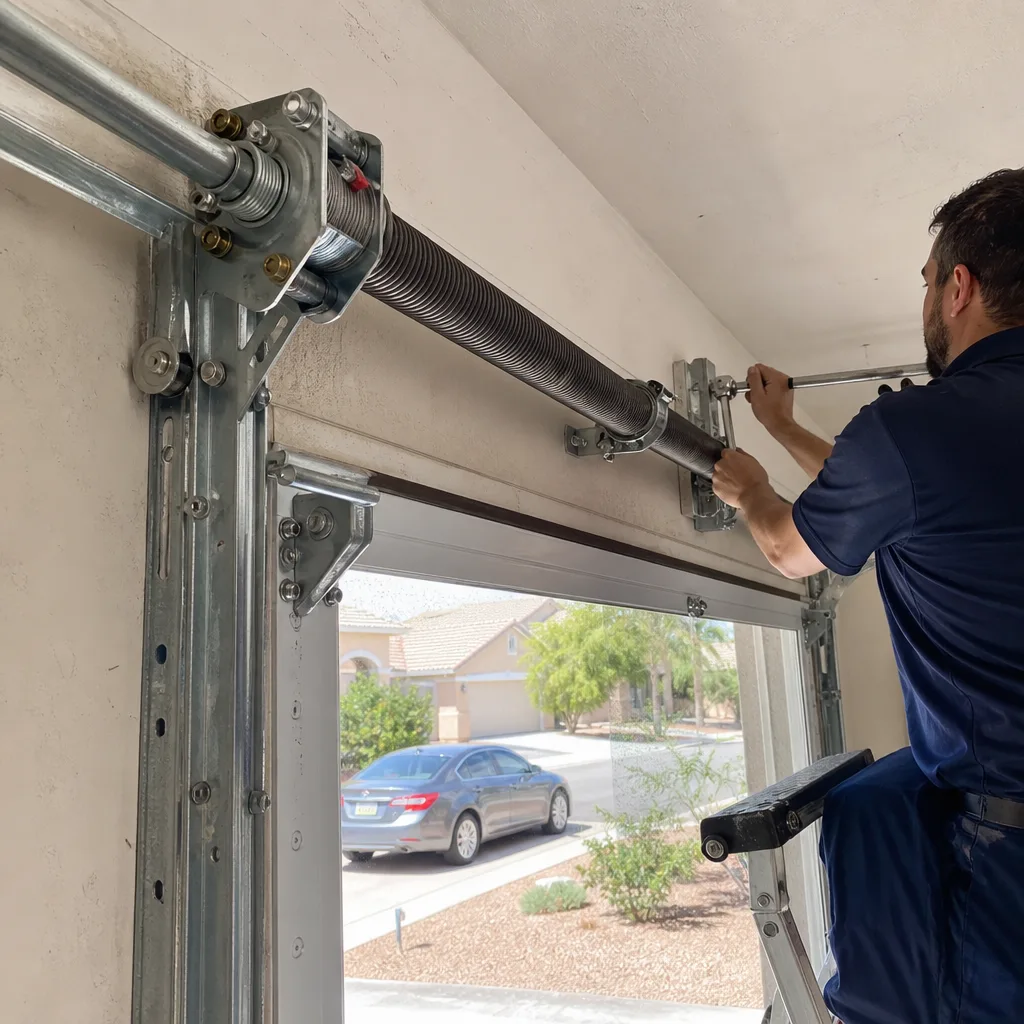 After
After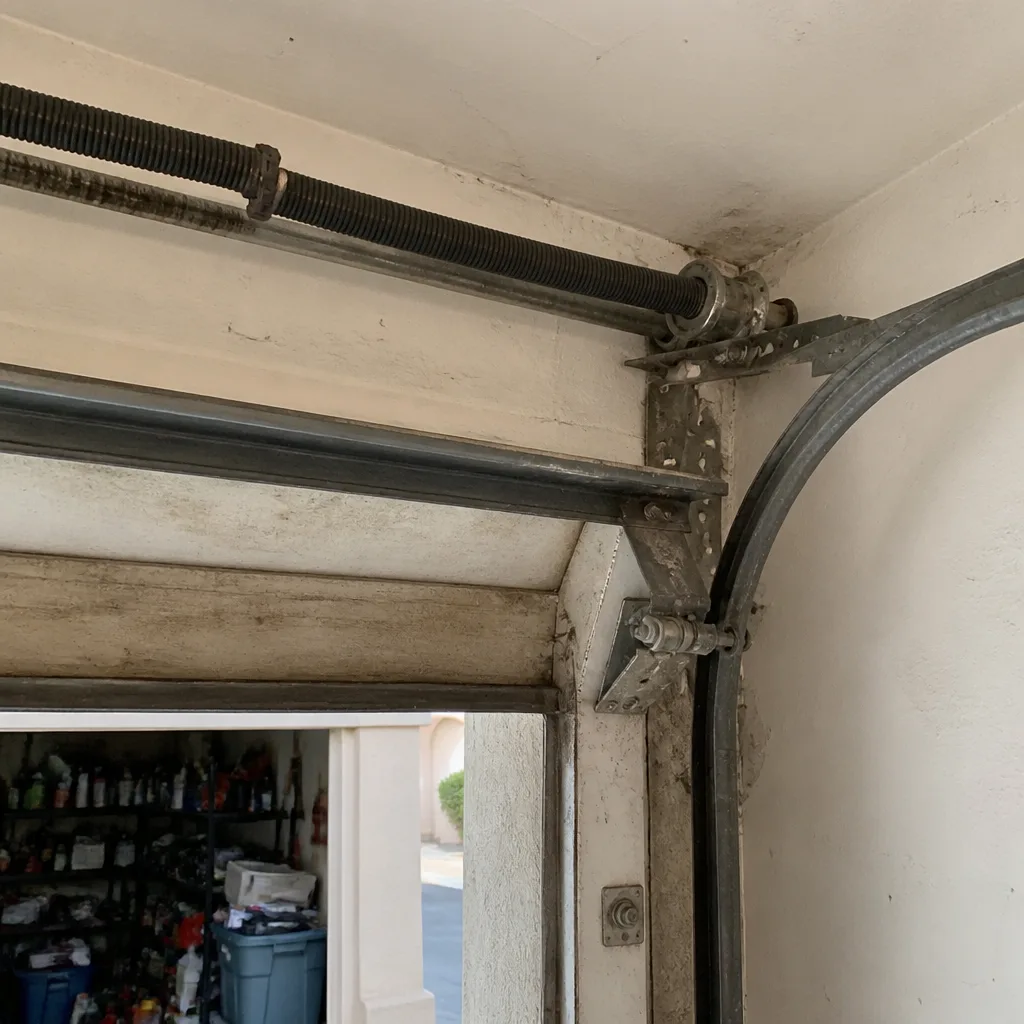 Before
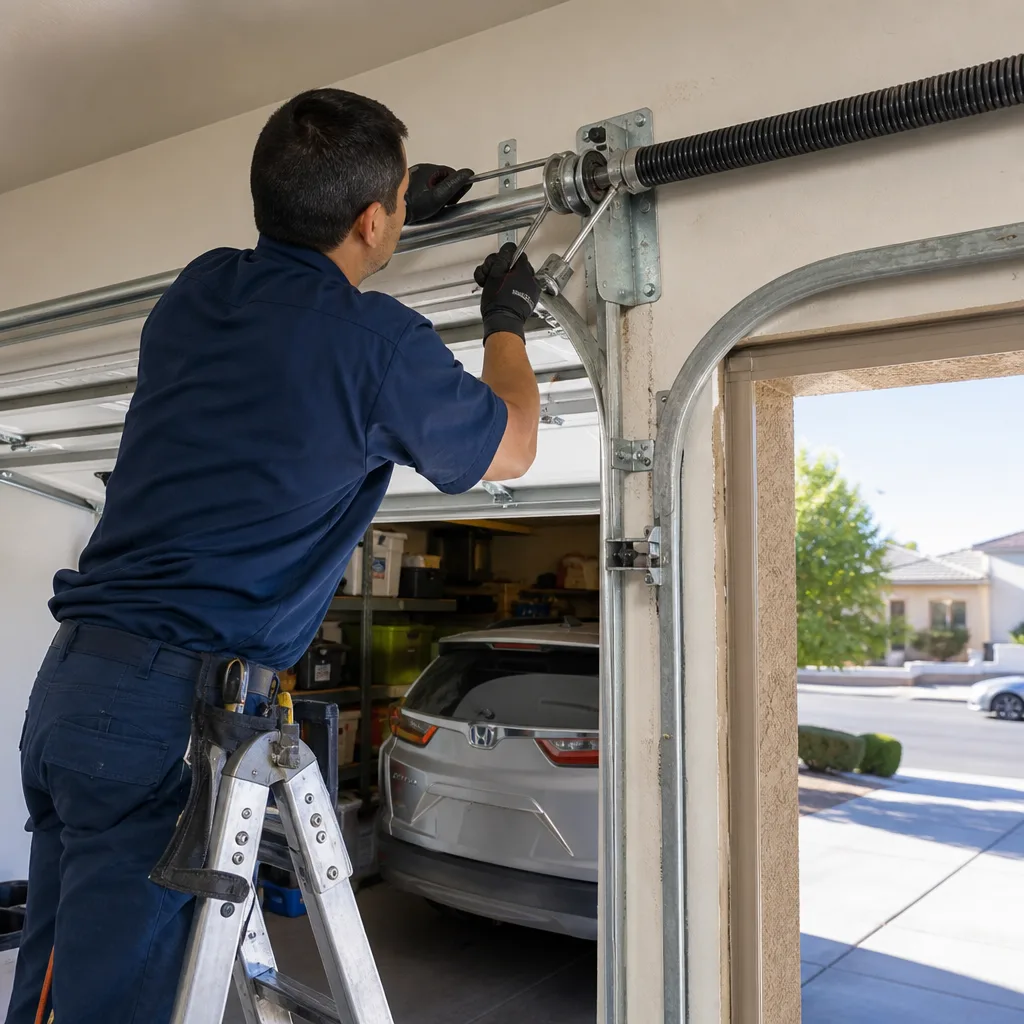 After
After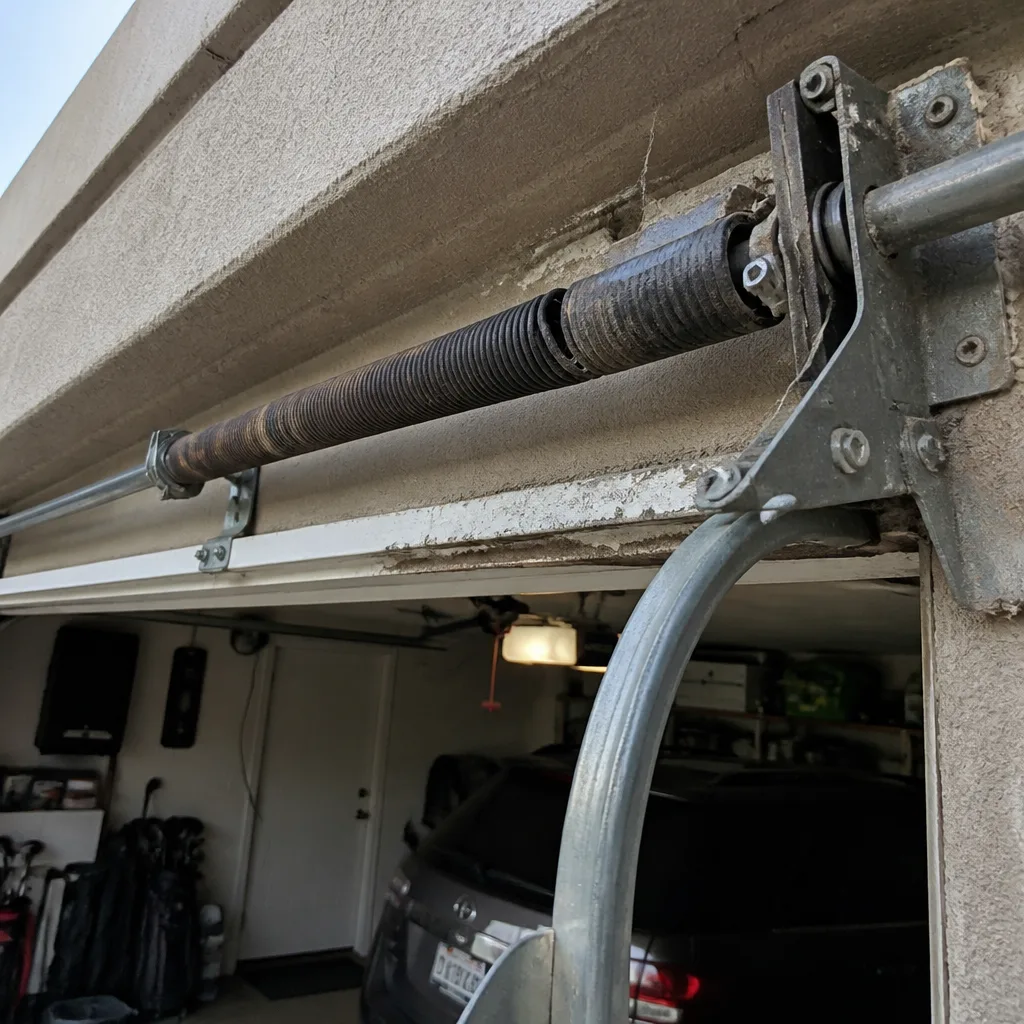 Before
 After
AfterSeasonal Garage Door Care for Chandler: Year-Round Homeowner’s Guide
Chandler’s summer ambient garage temperature routinely reaches 130°F. At that heat, standard garage door lubricants thin out and drip off the components they were applied to, leaving metal grinding on metal by August. Most homeowners don’t discover this until the opener strains, the door jerks, or a roller seizes. This guide explains what actually degrades on a garage door in Chandler’s climate, when each failure tends to occur, and what to check in any given month-complementing our The Complete Guide to Garage Door in Chandler with seasonal specifics. It’s written so you can do the safe, simple checks yourself and know exactly when to bring in a technician.
Quick Answer
Seasonal garage door care in Chandler means working around two distinct stress phases, not four seasons: UV exposure and thermal expansion from April through October, and metal contraction plus dust infiltration from November through March. In practice, most Chandler homeowners should lubricate with a high-temperature synthetic lubricant in April, inspect weatherstripping for UV brittleness by June, recheck spring tension in November after the first major temperature swing, and clear track debris after every monsoon storm. A documented photo record taken at the start of each phase gives any technician a baseline comparison when quoting a repair.
Table of Contents
- Phase 1 (April-October): Heat, UV, and Thermal Expansion
- Phase 2 (November-March): Contraction, Temperature Swings, and Dust
- Month-by-Month Task Table for Chandler
- Lubrication in Chandler: What Actually Works Above 100°F
- How to Test Whether Your Insulated Door Still Performs
- Why a Photo Baseline at Each Phase Change Matters
- Safety: What a Homeowner Should Never Do
- Common Mistakes to Avoid
- When to Call a Professional
- Frequently Asked Questions
- The Bottom Line
BeforeAfterPhase 1 (April-October): Heat, UV, and Thermal Expansion
Chandler’s hot season runs roughly from late April through mid-October, with sustained daytime highs above 100°F from June through September. Garage door components expand as ambient temperature climbs, and that expansion changes how the door behaves. Metal rails lengthen slightly. Nylon rollers soften. Rubber weatherstripping cooks in direct sun on south- and west-facing garage doors. The failure patterns we see most often during this phase are predictable: dried or liquified lubricant, cracked bottom seals, and opener motors tripping their thermal overload from working against an expanded, sluggish door.
What to Inspect in April, Before the Heat Peaks
- Lubricant on rollers, hinges, and torsion springs. If the existing lubricant is wet or sticky, wipe it off and reapply a high-temperature synthetic garage door lubricant, not WD-40. WD-40 is a solvent and will strip what little protection remains. A lithium-based or PTFE-based garage door lubricant holds up longer when Chandler garage interiors sit above 110°F for weeks.
- Weatherstripping along the bottom edge and side jambs. Press it with a thumbnail. If it feels stiff or leaves a white crease mark, UV has begun breaking it down. Rubber weatherstripping in Chandler typically lasts two to four years before it becomes brittle enough to crack and let dust, insects, and cooled air escape.
- Opener force settings. Watch the door travel the last six inches before closing. If it slows noticeably or reverses without contacting the floor, thermal expansion may have increased rail friction. A quick opener force adjustment is a ten-minute fix; ignoring it leads to a burned logic board by July.
- Photo record. Take five photographs with your phone: the left torsion spring, right torsion spring, bottom seal, each roller track, and the opener rail. Name the album “Garage Door April Baseline” and keep it. You’ll see why in the photo baseline section below.
In our experience with garage door repair in Chandler, most August service calls involve either a seized roller or a stripped gear inside the opener. Both are heat-accelerated, and both are usually preventable with an April inspection and fifteen minutes of maintenance.
Mid-Summer Checks: June Through August
- Recheck the bottom seal. By late June, a south-facing garage door has absorbed two solid months of direct UV. Look for vertical cracks at the seal ends and any visible gap between the seal and the concrete slab. A gap wider than one-eighth of an inch will pull hot air and dust into the garage all day.
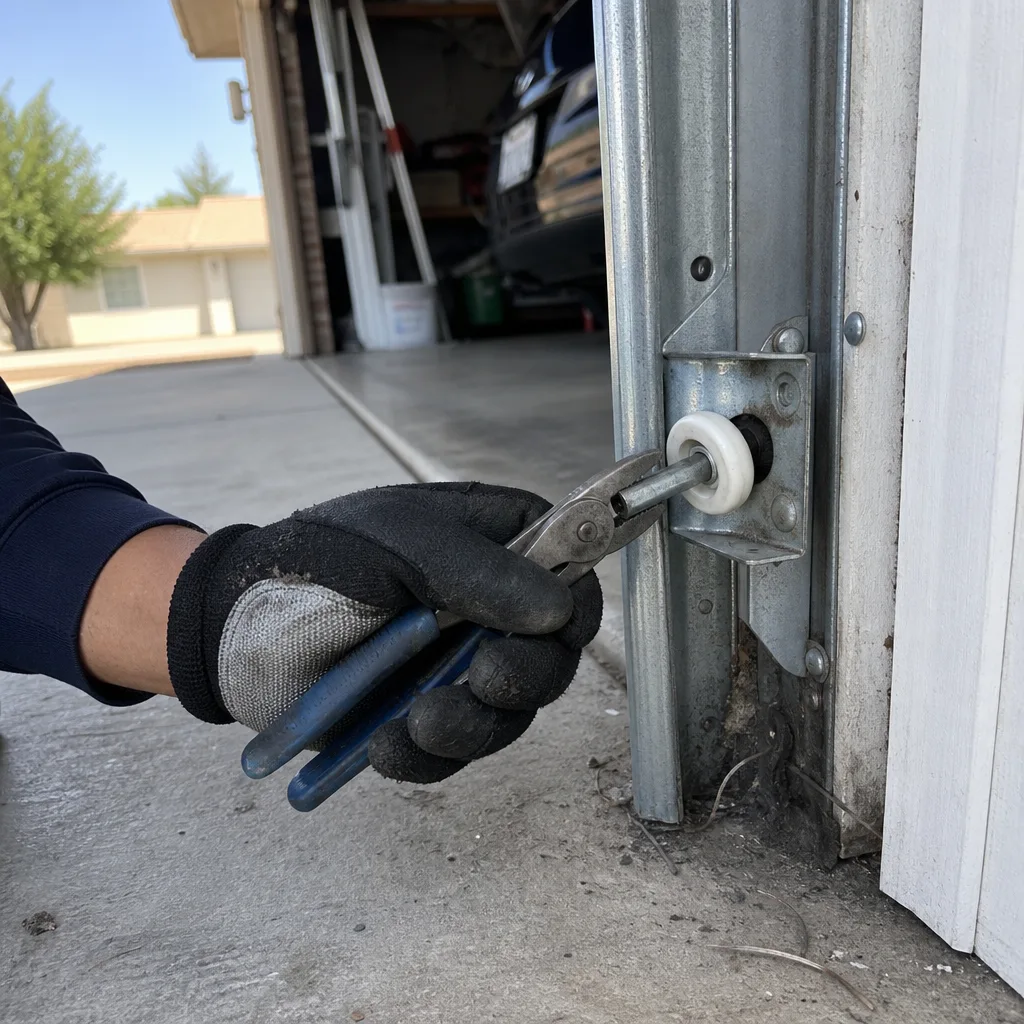
- Listen to the door for metal-on-metal sound. If you hear a scraping or grinding noise from the track, a roller bearing has likely failed. Nylon rollers with sealed bearings last longer in heat than steel rollers with exposed bearings. The sound is the bearing grinding; the fix is replacing the roller, not lubricating it.
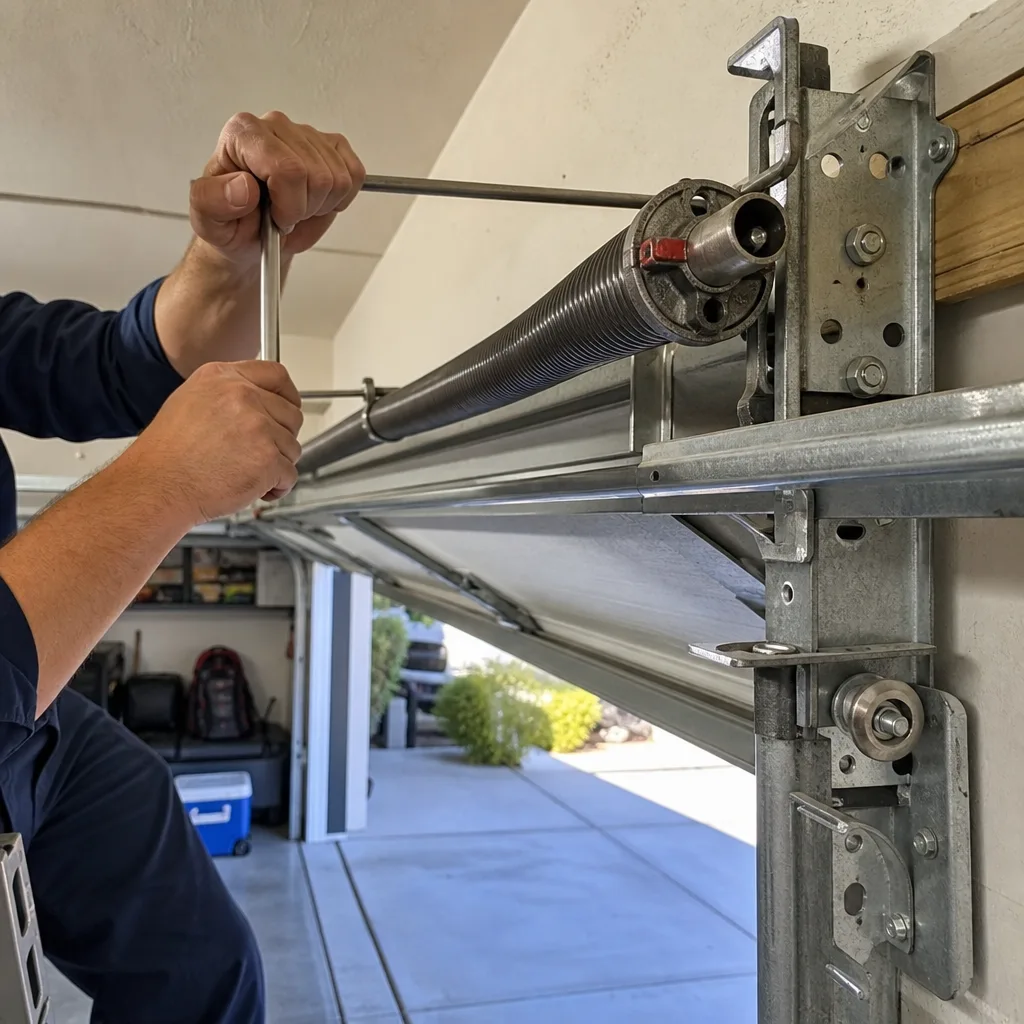
- Check the torsion spring color and surface. Surface rust does not mean the spring is failing, but rust scaling plus a rough feel when the door is in the closed position can indicate the spring is nearing the end of its duty cycle. Torsion springs in Chandler’s heat often fail between 10,000 and 15,000 cycles, which translates to seven to ten years for most single-family use.
Phase 2 (November-March): Contraction, Temperature Swings, and Dust
Chandler’s cooling season is not winter in the traditional sense, but it brings its own component failures. Nighttime lows from November through March regularly drop into the 40s and occasionally the 30s, while daytime highs can still reach the 70s. That’s a 30-to-40-degree daily temperature swing. Metal components contract overnight and expand by midday. Dust from the now-dormant desert landscape drifts into garage door tracks whenever wind kicks up after monsoon season. Together, these two forces produce the second wave of seasonal failures: spring tension imbalance, track debris accumulation, and opener limit switch drift.
November: After the First Cold Snap
- Disconnect the opener and operate the door manually. Pull the emergency release cord and lift the door halfway. Release it. The door should hold position. If it drifts downward, the torsion spring has lost tension. If it climbs upward, the spring is over-tensioned. Either condition means the spring needs adjustment, which is a job for a trained technician because the torsion spring is under lethal tension at all times, even when the door appears motionless.
- Check the balance in three positions. Manually raise the door to one-quarter, one-half, and three-quarter height, releasing at each point. A properly balanced door holds at each position. A door that drops at the halfway point but holds at the top indicates a spring losing its rated torque from years of heat cycling.
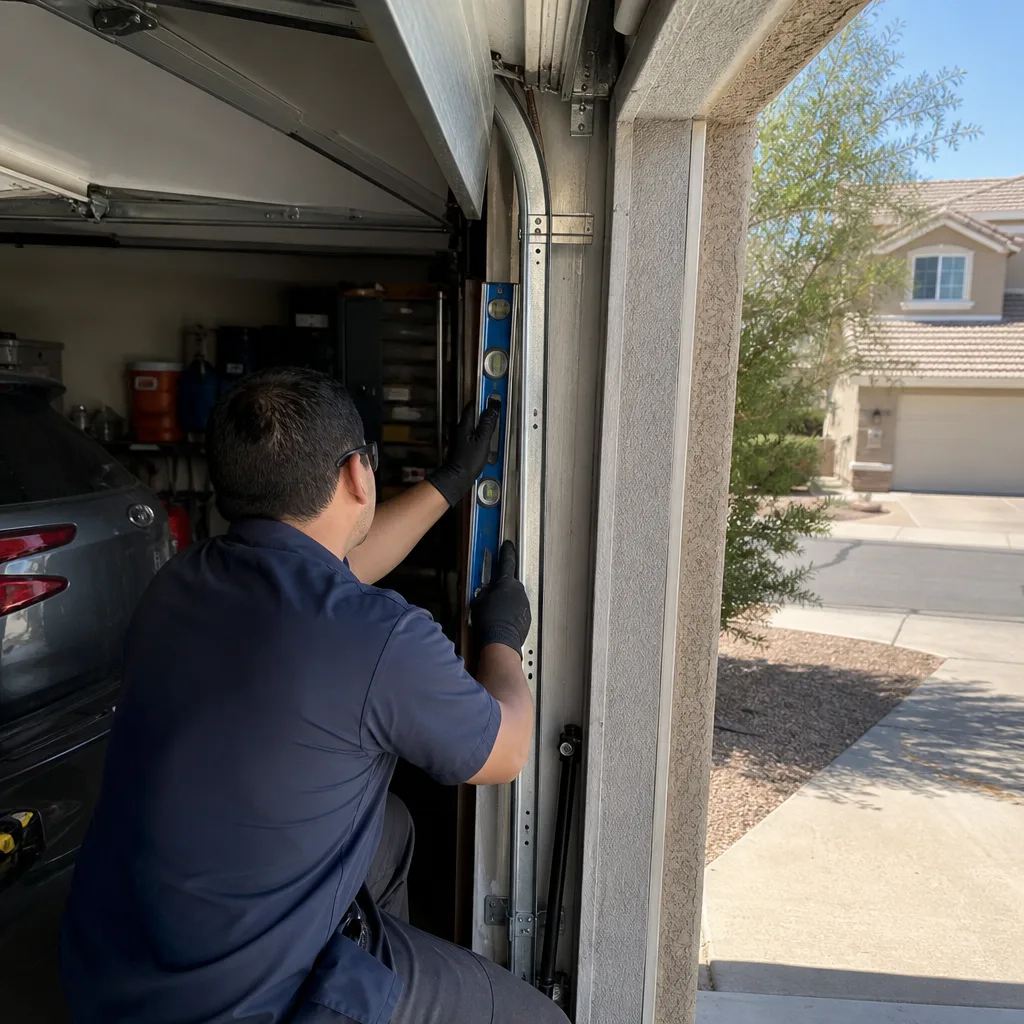
- Inspect the photo-eye alignment. Temperature swings cause the mounting brackets holding the safety sensors to expand and contract at slightly different rates from the wall material. Even a two-degree shift can break the infrared beam and prevent the door from closing. Check that both sensor lenses are aligned and free of dust film.
- Take a second photo set. Same five positions, new album named “Garage Door November Baseline.” Compare side by side with the April photos. If a spring looks different, a seal has visibly deteriorated, or a track shows new corrosion, you have documentation of the change.
December Through March: Dust, Limit Switches, and Opener Logic Boards
By December, dust that entered the track during monsoon storms has typically worked its way into the roller bearings and the opener rail. The symptoms are a door that jolts at a specific point in its travel or an opener that reverses mid-cycle for no apparent reason. Both conditions point to debris interfering with smooth travel, not to a broken spring or a failed opener. Clean the track with a dry cloth, never with water or solvent, which leaves residue that attracts more dust.
Limit switch drift is the other cold-season signature. As the door and rail contract at night and expand during the day, the physical position where the opener thinks “fully closed” changes by fractions of an inch. Over weeks, those fractions accumulate. The result is a door that stops one inch above the concrete, or reverses after touching down. Adjusting the limit switches is a five-minute job, but on newer openers like LiftMaster and Chamberlain, the adjustment is done through a menu, not a screw, and the sequence is not intuitive. If you’re not certain, have a technician do it and watch how the adjustment is made.
Month-by-Month Task Table for Chandler
The table below maps maintenance tasks to Chandler’s actual average temperature and precipitation calendar. Use it as a checklist. Each task takes less than thirty minutes and needs no special tools beyond a step ladder, a dry cloth, a phone camera, and a can of high-temperature garage door lubricant.
| Month | Average High / Low | Typical Weather Pattern | Task | Time |
|---|---|---|---|---|
| January | 67°F / 43°F | Cool, dry, occasional rain | Manual balance check. Verify opener reversal works. Check limit switch position. | 20 min |
| February | 71°F / 46°F | Mild, dry | Lubricate rollers, hinges, and springs with high-temp lubricant. Inspect weatherstripping. | 15 min |
| March | 77°F / 50°F | Warming, low humidity | Clear any remaining track debris. Photograph baseline set for the hot season. | 10 min |
| April | 85°F / 56°F | First 100°F days possible | Apply fresh lubricant before heat peaks. Check bottom seal for early UV cracking. | 15 min |
| May | 94°F / 64°F | Hot, dry, windy | Clean and re-align safety sensors. Verify opener force settings still appropriate. | 15 min |
| June | 103°F / 72°F | Peak heat begins | Reinspect weatherstripping at both ends. Check for metal-on-metal sound from rollers. | 10 min |
| July | 106°F / 79°F | Monsoon humidity, dust storms | After first monsoon storm, clear track of dust and debris. Verify door closes fully. | 20 min |
| August | 105°F / 78°F | Monsoon continues, high dust | Check roller bearings for grit. Re-lubricate if monsoon dust has contaminated moving parts. | 15 min |
| September | 100°F / 73°F | Hot, humid, occasional storms | Final hot-season lubricant check. Photograph door condition before cooling season. | 15 min |
| October | 90°F / 62°F | Cooling begins | Deep clean tracks. Inspect torsion springs for surface rust or rough patches. | 20 min |
| November | 76°F / 49°F | First major temperature swings | Disconnect opener and run manual balance test. Adjust sensors if drifting. Take photo baseline. | 20 min |
| December | 66°F / 42°F | Cool nights, dry | Verify travel limits. Check door closes flush to concrete. Inspect cables for fraying near drum. | 15 min |
If you only do four tasks per year, make them these: April lubrication, June weatherstripping check, November manual balance test, and post-monsoon track cleaning. Those four map to the four most common seasonal failures we document in Chandler.
Lubrication in Chandler: What Actually Works Above 100°F
Standard garage door lubricants are formulated for moderate climates, typically rated for continuous temperatures below 100°F. Chandler garage interiors exceed that for four to five months of the year. At 110°F ambient, ordinary petroleum-based lubricants thin to the consistency of water, run off the roller pins and hinge barrels, and leave the metal surfaces exposed. At 130°F, which is common on an uninsulated garage door panel in direct afternoon sun, even some synthetic sprays fail.
The specification that matters for Chandler is the lubricant’s temperature range, not the brand. Look for a garage door lubricant rated for continuous use above 120°F, with either a PTFE base or a lithium complex base. Genie makes a PTFE-based garage door lubricant that holds up well in desert heat, as does Raynor. Avoid anything labeled as a penetrating oil, silicone spray intended for interior use, or general-purpose household lubricant. These break down quickly and leave behind a tacky residue that collects dust, which defeats the purpose of lubricating in the first place.
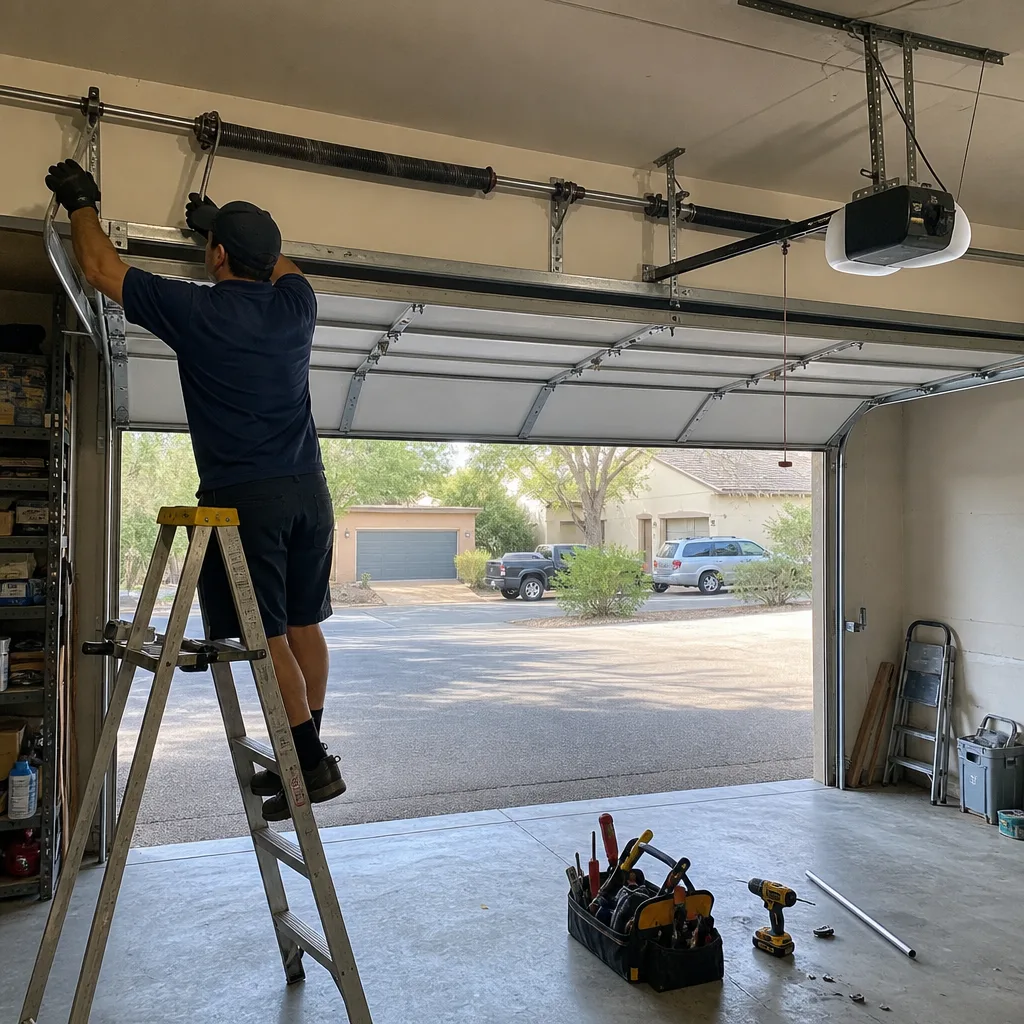
Apply lubricant to the roller bearings, hinge pivots, torsion spring coil faces, and the opener rail. On a torsion spring, spray along the full length of the coils, not just the visible front face. The spring coils slide against each other constantly as the door cycles, and that metal-on-metal contact is where heat and wear concentrate. On a LiftMaster belt-drive opener, do not lubricate the belt itself. Belts are self-lubricating by design, and adding lubricant attracts dust that wears the belt prematurely.
In Chandler’s monsoon season, dust contamination undoes lubrication quickly. Reapply lubricant after any major dust storm, even if you applied it only weeks earlier. The dust settles on lubricated surfaces, mixes with the lubricant, and forms an abrasive paste. That paste accelerates roller bearing wear faster than no lubrication at all. The visual tell is a greasy brown film on the track. If you see that, wipe it off and apply fresh lubricant.
How to Test Whether Your Insulated Door Still Performs
Insulated garage doors are marketed by R-value, but R-value assumes the panel is intact and the seals are functioning. A door with an R-12 rating that has compressed weatherstripping, a warped bottom seal, or gaps at the panel joints may perform no better than an uninsulated door. The test below takes ten minutes and tells you whether your insulated door is actually doing the job you paid for.
You’ll need an infrared thermometer, the kind that sells for $20 to $40 at any hardware store and reads surface temperature at a distance without contact. Run the test in the late afternoon on a hot day, between 4 and 6 p.m., when the garage door has absorbed maximum solar gain.
- Aim the IR thermometer at the garage door’s exterior surface from six inches away. Record the temperature. On a 105°F day, a south-facing door can read 130°F to 140°F on the exterior panel face.
- Move inside the garage and aim at the interior surface of the same panel. Record that temperature. A functioning insulated door should show an interior surface at least 15°F to 20°F cooler than the exterior. An R-12 or higher panel on a properly sealed door often shows a 25°F difference.
- Check the temperature at the panel joints. Aim at the seam where two panels meet, both from inside. If the seam reads noticeably warmer than the panel center, the joint seal has failed and thermal bridging is occurring.
- Check the temperature at the bottom corners where the door meets the concrete and the side jambs. If those areas read more than 10°F warmer than the panel center, the weatherstripping is leaking. That temperature differential is what you’re paying for when you replace a bottom seal.
- Repeat the test once in January on a cold morning. A functioning insulated door should show an interior surface warmer than the exterior. If the differential collapses to under 10°F, the insulation or seals have degraded.
This test is part of what we document when assessing whether an garage door installation in Chandler should be insulation-only or full-panel replacement. A door that fails the thermal test but is structurally sound often needs only new weatherstripping and possibly new panel joint seals, not a new door. That’s the difference between a $200 fix and a $2,000 one, and it’s exactly the kind of decision that a written inspection report makes straightforward.
Why a Photo Baseline at Each Phase Change Matters
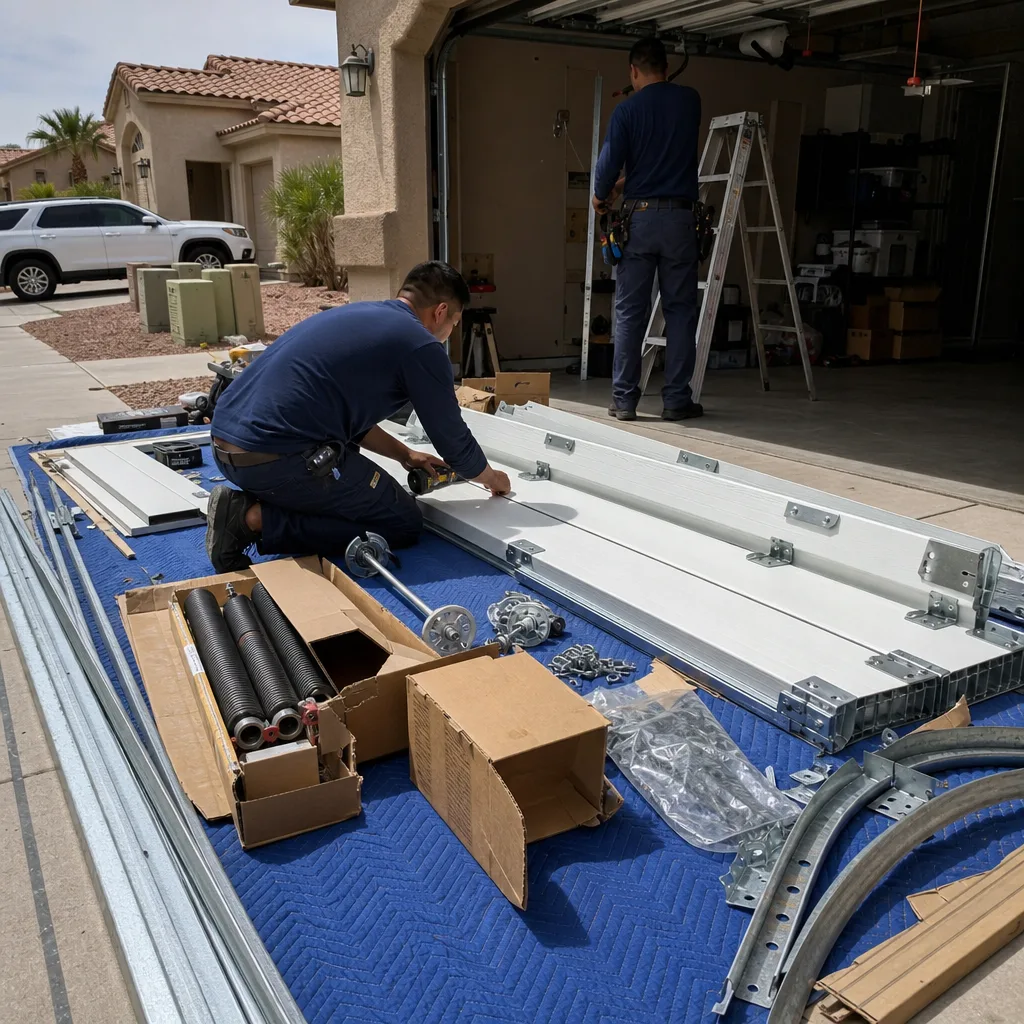
The single most useful habit a Chandler homeowner can develop is photographing the garage door’s key components at the start of each season. We’re not talking about a well-lit portrait of the door from the driveway. We’re talking about five specific close-up photographs, taken from the same angles each time, stored in a labeled folder on your phone.
Here’s what to photograph and why it becomes valuable:
- The torsion spring, both sides. Springs don’t fail in one dramatic moment for most homeowners. They develop surface scaling, lose coil alignment, and show gap elongation over months. A dated photo series shows the progression. When a spring finally breaks, you or your technician can compare the before and after and confirm exactly what changed.
- The bottom seal, full width. Cracks start at the ends and propagate inward. A March photo next to a September photo of the same seal shows whether cracking accelerated over one hot season or developed gradually. That tells you whether to expect replacement every two years or every four.
- Each roller track at eye level. Dust accumulation is seasonal in Chandler. After monsoon, tracks accumulate a visible gray film. A dated photo from April, when tracks are clean, makes the post-monsoon condition obvious.
- The opener rail and chain or belt. Sag, rust, and belt wear all show up in photographs before they show up as operational failures.
- The safety sensor mounting brackets. If a sensor has shifted, the photo shows the tilt immediately, which is faster than troubleshooting by symptom.
The reason this matters for repair quotes specifically is Clause 4 of The Haven Standard, the standard under which Servo Garage Doors Chandler operates: the technician photographs the failed component before quoting a replacement. If you already have a photo baseline from six months earlier, there’s immediate context for what changed and when. A spring that was clean in April and broken in November tells a different story than one that showed scaling in April and finally failed. The first is a sudden failure. The second is a predictable one that should have been planned for. Both are repairable, but the homeowner who sees the progression has the information to budget for the repair before it happens, rather than after the door is stuck in the open position at 10 p.m.
Your photo record also gives you leverage when comparing repair quotes. If a contractor tells you the spring needs replacement and you have a photo from eight weeks ago showing a clean spring, you can ask a better question: what changed in eight weeks? Sometimes the answer is legitimate. Sometimes it isn’t. The photo lets you tell the difference.
Safety: What a Homeowner Should Never Do
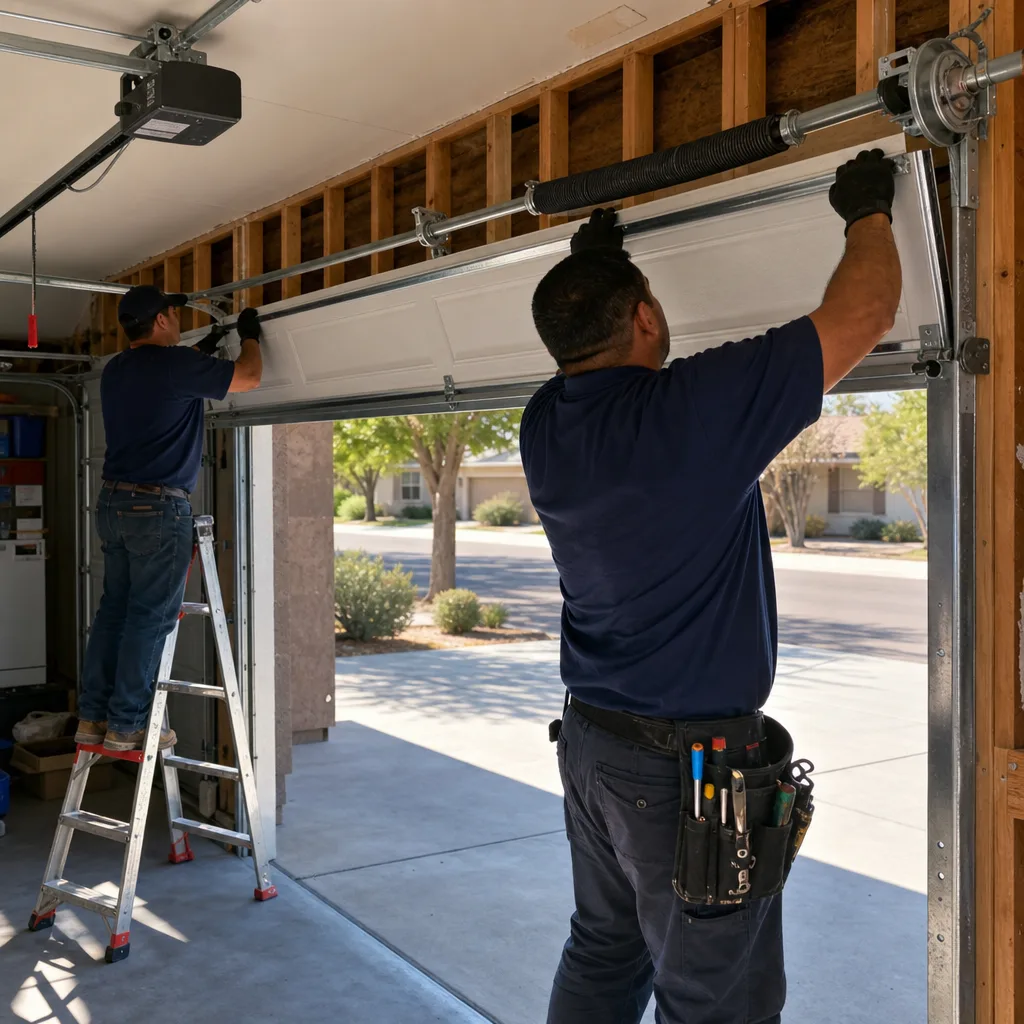
Most garage door maintenance is safe for a careful homeowner. There are two components that are never safe for do-it-yourself work, and both require a specific sequence of tools, training, and caution that cannot be communicated in a guide. The first is the torsion spring, the long coiled spring mounted above the door opening. A torsion spring holds the full weight of the door, typically 150 to 400 pounds of stored mechanical energy. If it releases while you’re working on it, the result is often catastrophic injury. Even when the door is in the closed position and the spring appears still, it is under tension. Do not adjust it, do not remove it, do not attempt to wind or unwind it. Call a trained technician.
The second is the lift cable, the steel cable that runs from the bottom bracket up to the cable drum. Lift cables carry the door’s weight alongside the springs. When a cable frays and snaps, it whips with enough force to sever fingers or cause deep lacerations. You can visually inspect cables for fraying and rust, but you should never touch a cable that is under tension or attempt to re-thread a cable that has come off its drum. In both cases, the inspection is safe. The repair is not.
There’s a third category worth mentioning: opener logic boards. Working on an opener’s electrical components with the unit plugged in is an electrocution risk, and even with the unit unplugged, stored charge in the capacitor can deliver a shock. If the problem is inside the opener housing, unplug the unit and call a professional. The cost of a service call is a fraction of an emergency room visit.
Common Mistakes to Avoid
- Using WD-40 as garage door lubricant. WD-40 is a water-displacing solvent, not a lubricant. It strips existing lubricant and leaves metal surfaces vulnerable to oxidation. In Chandler’s heat, the effect is worse because the stripped surface expands rapidly and accelerates wear on rollers and hinges. Use a high-temperature PTFE-based or lithium-based garage door lubricant instead.
- Lubricating the belt on a belt-drive opener. Belt-drive openers from LiftMaster and Chamberlain have belts made of a self-lubricating composite. Adding lubricant makes the belt slick for the first week, then sticky as dust accumulates, which increases motor load and shortens the opener’s life. If a belt-drive opener is noisy, the problem is elsewhere, typically the rail or the sprocket.
- Ignoring a door that closes most of the way but not completely. A door that stops one inch above the concrete or reverses at the last moment is telling you the limit switches or the force settings need adjustment. Ignoring it for weeks causes the opener motor to work harder on every cycle, which burns out the logic board eventually. In Chandler’s summer heat, that failure arrives faster than you’d expect.
- Waiting until the door fails to schedule maintenance. A garage door shows progressive symptoms before most failures: increasing noise, slower travel, slight jerking, balance drift. Each of those is a maintenance window. By the time the door won’t open at all, a repairable condition has often become a replacement-level repair. The spring that was adjustable in October is broken by January.
- Washing the track with water or solvent. Water evaporates and leaves behind whatever minerals it carried, which then attract and hold dust from the next monsoon storm. Solvents strip the protective coating from galvanized track steel. A dry cloth is the right tool. If the track needs more than a dry wipe, something else is wrong.
- Adjusting the torsion spring based on a YouTube video. The video does not convey the spring’s stored energy. More than one experienced technician has been injured by a spring that let go during an adjustment. The $150 to $250 a professional charges for spring adjustment in Chandler is the cost of not risking your hands, your face, or your life.
- Not photographing the door before calling for repairs. A homeowner who has no photo record is negotiating with no evidence. A homeowner who has a dated photo series is working from documentation. The second homeowner gets better diagnostic conversations and more accurate quotes because there’s a baseline to compare against.
When to Call a Professional
Call a professional if the door has come off its track, if a lift cable shows fraying, if the torsion spring is visibly broken or sagging, or if the opener makes a grinding sound and won’t move the door. Also call if the door fails a manual balance test, if the opener reverses mid-cycle repeatedly after you’ve cleaned the sensors, or if you notice the door jerking at a specific point in its travel that persists after lubrication. These are safety-critical conditions that need a trained technician, and most of them involve components under tension or current. Servo Garage Doors Chandler offers free estimates in Chandler, with a flat written price and written scope before any work begins, plus a documented photo record of what the technician found and what was fixed. Call (520) 482-1879 if you need a professional diagnosis, or use the garage door opener repair and installation page to see what’s involved before you pick up the phone.
Frequently Asked Questions
Lubricate your garage door every four months in Chandler, with a high-temperature synthetic garage door lubricant rated for continuous ambient temperatures above 120°F. The heat cycle from April through October thins ordinary lubricants, and monsoon dust contaminates whatever remains, so April and August are the two most important months for fresh lubrication.
A seasonal garage door tune-up in Chandler typically costs between $85 and $180 when performed as a standalone service, depending on whether it includes opener adjustments and any minor parts like a bottom seal. Repairs found during a tune-up are quoted separately, and at Servo Garage Doors Chandler the quote is a flat written price with a written scope, delivered before any work begins. Call (520) 482-1879 for a free estimate.
Yes, most seasonal maintenance is safe for homeowners: lubrication, weatherstripping inspection, track cleaning with a dry cloth, sensor alignment, and manual balance checks are all in range for a careful DIYer. The two jobs that should always be left to a professional are torsion spring adjustment and cable repair, because both involve components under lethal tension and can cause serious injury if the release is uncontrolled-covered in depth in our DIY vs Professional Garage Door: The Chandler Homeowner’s Decision Guide.
Chandler’s winter temperature swings cause metal components to contract at night and expand during the day, which drifts the opener’s limit switch position and can cause the door to stop an inch short or reverse before it reaches the floor. The same door works fine in summer because the components stay at a consistent expanded size. The fix is usually a five-minute limit switch adjustment, though newer models require menu-based adjustment rather than a physical screw.
Disconnect the opener with the emergency release cord, then lift the door to the halfway point. A healthy spring holds the door in place at the midpoint. If it drifts downward, the spring has lost tension. If it climbs upward or feels heavy at the bottom of the travel, the spring is over-tensioned or bound. Both conditions mean the spring needs professional adjustment.
The photo record is the cheapest diagnostic tool you own. A dated photograph of each component at the start of the season gives any technician a baseline to compare against when quoting a repair. At Servo Garage Doors Chandler, every visit ends with a documented photo record of what was found and what was fixed, which is why the photo baseline you keep on your phone makes the conversation faster and the quote more precise.
The Bottom Line
Chandler’s garage doors fail on a two-phase schedule, and the homeowner who knows the schedule stays ahead of the failures. Lubricate with high-temperature material in April and August, inspect weatherstripping for UV cracking by June, run a manual balance test in November, and clear dust from the tracks after every monsoon storm. Document each phase with five photographs so you have a baseline comparison for the next inspection and any future repair conversation. Most of this takes less than thirty minutes a month. The repairs it prevents, from stripped opener gears to snapped torsion springs, cost hundreds or thousands more.
Written by Marcus Deller, Owner at Servo Garage Doors Chandler, serving Chandler since 2015.